Rh Incompatibility
What is the basis of classification of blood groups and what are the uses of blood grouping? Add a note on Rh+ blood. (or) Rh incompatibility. (or) Rh group.
Answer:
Classification of blood groups:
- It is based on the presence or absence of a specific agglutinogen or antigen on the surface of the red cell membrane.
“Understanding Rh incompatibility through FAQs: Composition, functions, and uses explained”
- The most important blood groups are:
1. ABO system.
- It is based on the presence of absence of antigen A and antigen B blood is divided into 4 groups.
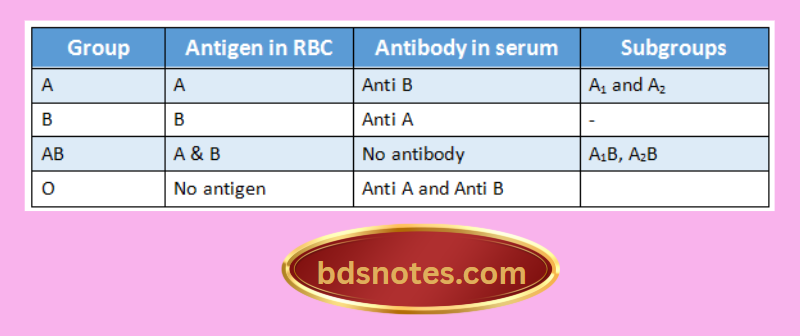
“Importance of studying Rh incompatibility for medical students: Questions explained”
2. Rh Blood group.
- Rh factor is an antigen present in RBC.
- It was first discovered by Landsteiner and Weiner in rhesus monkey.
- The persons having D antigen are called Rh positive and those without D antigen are called Rh negative.
- Rh antibodies are of the IgG type and the antigen – antibody reaction occurs best at the body temperature.
Principles of blood grouping:
- Blood grouping is done on the basis of agglutination which means clumping of RBCs
- Agglutination occurs when a specific antigen called iso aggulatinin.
- Thus, agglutination occurs when antigen A is mixed with Anti-A or when antigen B is mixed with Anti-B.
Uses of blood grouping:
- In blood transfusion to avoid blood transfusion reactions.
- For matching tissues during organ transplantation.
- Investing cases of paternity disputes.
- If one knows his/her blood group, it may be helpful in emergency conditions.
- In pregnancy to prevent the complications due to Rh incompatibility.
- For research purposes.
- Anthropological purposes.
“Factors influencing success with Rh incompatibility studies: Q&A”
Rh blood:
- Rh blood group system is not detected in tissues other than RBCs.
Rh blood Inheritance:
- Rh factor is an inherited dominant factor.
- It is inherited from both the parent.
- It may be homozygous positive DD, heterozygous negative Dd, or homozygous negative dd.
Rh antibody:
- It is not usually present in the plasma.
- But, its production can be evoked in Rh negative individuals by.
- Transfusion with Rh positive blood.
- Entrance of Rh-positive blood from foetus into the circulation of Rh negative mother.
“Steps to explain functions of Rh incompatibility: Immune response vs fetal hemolysis: Q&A guide”
Rh Complication:
- When Rh negative person receives Rh positive blood for the first time, he is not much effect but antibodies are produced within one month.
- These are lysed by macrophages and a mild delayed transfusion reaction occurs.
- But when the received Rh positive blood for the second time, severe transfusion reaction occurs immediately which may lead to jaundice, cardiac shock or renal shutdown.
- When a Rh negative mother carries a Rh positive fetus, usually the first child escapes the complications of Rh incompatibility.
- At the time of delivery the Rh antigen from foetal blood leaks into mother’s blood.
- When the mother conceives for the second time and if the fetus happens to be Rh positive again, the Rh antibody from mother’s blood enters the fetal blood.
- This causes agglutination of fetal RBCs resulting in hemolysis.
“Differential applications of pharmacological vs non-pharmacological treatments: Questions answered”
Rh Prevention:
- Anti D should be administered to the mother at 28th and 34th weeks of gestation.
- Anti D should be administered to the mother within 48 hours after delivery.
Leave a Reply