Recent Advances In Surgical Technology In Periodontics
“Understanding the role of new technologies in periodontal surgery”
Question 1. Write short note on magnifying loupes.
Answer. Dental loupes are the most common system of optical magnification used in periodontics.
- Loupes are fundamentally dual monocular telescopes with side-by-side lenses convergent to focus on the operative field.
- The magnified image formed has stereoscopic properties by virtue of their convergence.
- A convergent lense optical system is called as Keplerian optical system.
- There are several disadvantages associated with dental loupes, i.e. clinician’s eyes were strained, fatigued and even pathologic vision changes.
- Three types of Kelperian loupes are typically used in periodontics, i.e. simple loupes, compound loupes and prism telescopic loupes.
Read And Learn More: Periodontics Question And Answers
“Importance of studying technological innovations in periodontics”
Simple Loupes
Simple loupes consist of a pair of angle meniscus lenses. Simple loupes are primitive magnifiers with limited capabilities. Each lens is limited to only two refracting surfaces. Their magnification can only increase by increasing lens diameter and thickness. Size and weight constraints make simple loupes impractical for magnification beyond l.5X.
Compound Loupes
Compound loupes use multielement lenses with intervening air spaces to gain additional refracting surfaces. This allows increased magnification with more favorable working distance and depth of field. Magnification of compound loupes can be increased by lengthening the distance between lenses, thereby avoiding excessive size and weight.
“Common challenges in adopting advanced surgical technologies”
Prism Telescopic Loupes
The most advanced loupe optical magnification currently available is the prism telescopic loupe. Such loupes employ Schmidt or “rooftop” prisms to lengthen the light path through a series of switchback mirrors between the lenses. This arrangement folds the light so that the barrel of the loupes can be shortened. Prism loupes produce better magnification, wider depths of field, longer working distances, and larger fields of view than other types of loupes.
Magnification Range of Surgical Loupes
“Role of diode lasers in treating gum disease”
- Dental loupes provide a limited range of magnification (×1.5 to ×6).
- Loupes delivering magnification of less than ×3 are usually inadequate for the visual acuity necessary for clinical periodontics.
- Surgical loupes providing magnification of more than ×4 are impractical because of their small field of view, shallow depth of focus, and excessive weight.
- Excessively heavy loupes can make it difficult to maintain a stable visual field.
- For some periodontal procedures, prism telescopic loupes with magnification of ×4 provide an adequate combination of magnification, field of view, and depth of focus.
“Steps to use laser therapy in periodontal surgery”

“Early warning signs of complications with laser technology”
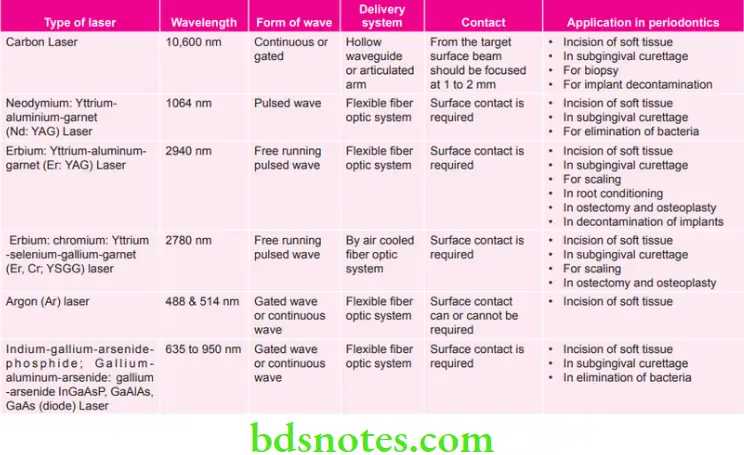
Question 2. Write short note on Lasers in periodontics.
Or
Write short note on Lasers.
Answer. Light amplification by stimulated emission of radiation (LASER) was first given by Maiman.
Following are the lasers used in periodontics:
“Asymptomatic vs symptomatic effects of improper laser use”
Leave a Reply