Pulmonary Embolism
Question 1. Write a brief note on pulmonary embolism.
Answer:
Pulmonary embolism is the most common and fatal form of venous thromboembolism in which there is occlusion of the pulmonary arterial tree by thromboembolic.
Pulmonary embolism Etiology
Pulmonary emboli are most common in hospitalized or bedridden patients. The causes are:
- Thrombi originates from large veins of the lower legs, femoral and iliac.
- Less common sources include thrombi in varicosities of superficial veins of legs and pelvic veins.
Pulmonary embolism symptoms
Pulmonary embolism Pathogenesis
- If the thrombus is large, it is impacted at the bifurcation of the main pulmonary artery or may be found in the right ventricle or its outflow tract.
- More commonly there are multiple emboli or a large. embolus may be fragmented into many smaller emboli which then impacted a number of small vessels, particularly the lower lobes of the lungs.
- Rarely paradoxical embolism may occur by the passage of an embolus from the right heart into the left heart through an atrial or ventricular septal defect. In this way, pulmonary emboli may reach the systemic circulation.
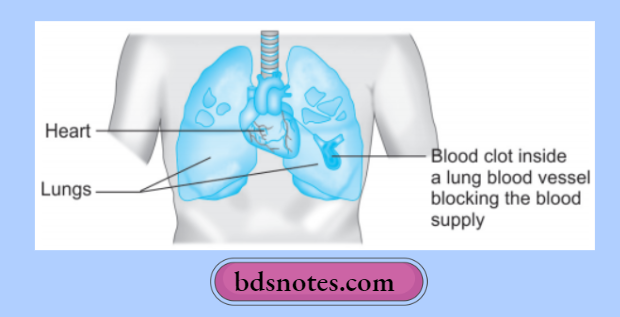
Consequences of Pulmonary Embolism
- Sudden death: Massive pulmonary embolism results in instantaneous death, without occurrence of chest pain or dyspnea. However, if the death is somewhat delayed, the clinical features resemble myocardial infarction, i.e. severe chest pain, dyspnea and shock.
- Acute cor pulmonale: Numerous small emboli may obstruct most of the pulmonary circulation resulting in acute right heart failure. Another mechanism is by the release of vasoconstrictor substances from platelets or by reflex vasoconstriction of pulmonary vessels.
- Pulmonary infarction: Obstruction of relatively small-sized pulmonary arterial branches may result in pulmonary infarction. The clinical features include chest pain due to fibrinous pleuritis, hemoptysis and dyspnea due to reduced functioning pulmonary parenchyma.
- Pulmonary hemorrhage: Obstruction of terminal branches (end arteries) leads to central pulmonary hemorrhage. The clinical features are hemoptysis, dyspnea, and less commonly, chest pain due to the central location of pulmonary hemorrhage. Sometimes, there may be concomitant pulmonary infarction.
- Resolution: Vast majority of small pulmonary emboli (60-80%) are resolved by fibrinolytic activity. These patients are clinically silent owing to bronchial circulation so that lung parenchyma is adequately perfused.
Pulmonary embolism causes
- Pulmonary hypertension, chronic cor pulmonale, and pulmonary arteriosclerosis: These are the sequelae of multiple small thromboembolic undergoing organization
rather than resolution.
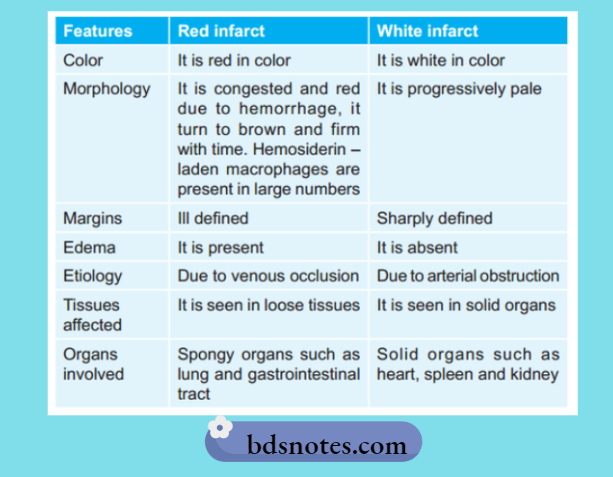
Question 2. Write the difference between red and white infarct.
Answer:
Leave a Reply