Protein Structure 101: From Primary to Quaternary Levels
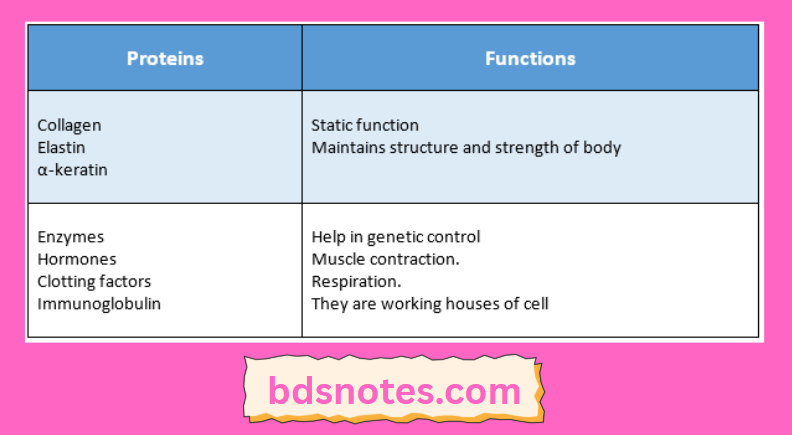
Question 1. Functions of proteins.
Answer:
- Proteins have a variety of specialized and essential functions.
- Its functions are grouped into static and dynamic functions.
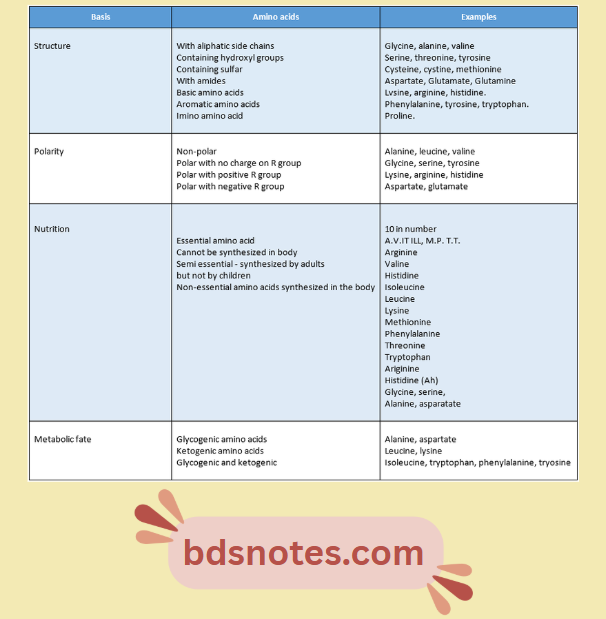
Question 2. Classification of Amino acids.
Answer:
Question 3. Limiting amino acids
Answer:
- It refers to essential amino acids in the protein which fall short of meeting the amino acids required by humans.
- They are determined by comparing the number of amino acids in a gram of protein to the number of amino acids per gram of protein required.
- These are limiting amino acids because if a person’s diet is deficient in any one of the amino acids, it will limit the usefulness of the others even if they are present in large quantities.
- It includes.
- Sulfur-containing amino acids.
- Methionine.
- Lysine.
Question 12. Structure of proteins.
Answer:
- Proteins are the polymers of L -α – amino acids.
- Its structure is divided into four levels.
1. Primary structure:
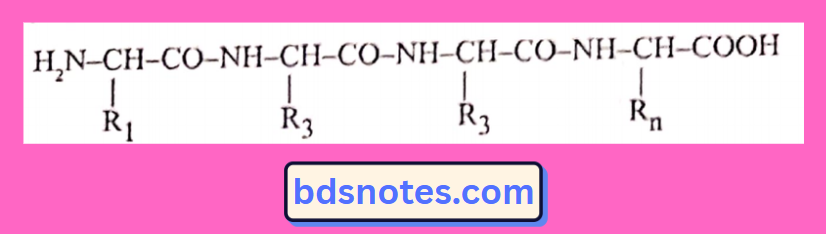
- It is the linear sequence of amino acids forming polypeptides.
- Amino acids are held together by peptide bond which is formed between the amino group of one amino acid and the carboxyl group of another amino acid,
2. Secondary structure:
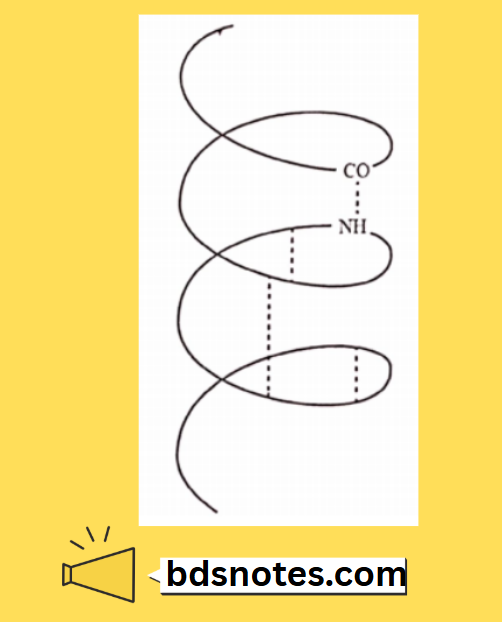
- The spatial arrangement of protein formed by twisting of the polypeptide chain is referred as secondary structure.
Types:
- α-Helix.
- Proposed by Pauling and Corey.
- It is a tightly packed coiled structure with amino acid side chains extending outwards from the central axis.
- It is stabilized by extensive hydrogen bonding formed between the H atom attached to peptide N and
O atom attached to peptide C. - It is the common spatial arrangement.
- It has a rigid arrangement of the polypeptide chain
- A right-handed helix is more stable than a left-handed one.
- β – pleated sheet.
- Proposed by Pauling and Corey.
- It is composed of two or more segments of fully extended peptide chains.
- Hydrogen bonds are formed in between the neighboring segments of polypeptide chains.
3. Tertiary structure:
- The three-dimensional arrangement of protein is referred to as a tertiary structure.
- It consists of hydrophobic side chains inside the molecules while hydrophilic on the surface of the molecule.
4. Quaternary structure:
- Some of the proteins contain two or more polypeptide chains called subunits.
- The spatial arrangement of it is referred to as a quaternary structure.
- Subunits are held together by non-covalent bonds like hydrogen bonds, hydrophobic bonds, and ion bonds.
Leave a Reply