Processing Of X-Ray Films
Question 1. Write short note on “X-ray developer”.
or
Write short note on developer.
or
Write short note on reducing solution.
Answer.
X-ray Developer:
- Developer distinguishes between the exposed and unexposed silver halide crystals.
- The developer initiates a chemical reaction that reduces the exposed silver halide crystals into metallic silver and creates dark or black areas on a dental radiography.
- At the same time, the unexposed silver halide remains virtually unaffected by the developer.
- The reducing agent acts as developer are catalyzed by neutral silver atoms at the latent image sites.
“Understanding the role of X-ray film processing in diagnostic imaging: Q&A explained”
Read And Learn More: Oral Radiology Question And Answers
X-ray Developing solution
The developing solution contains four components, all dissolved in water.
- Developer (Reducing agent).
- Activator.
- Preservative.
- Restrainer.
“Importance of studying X-ray film processing for better imaging outcomes: Questions explained”
X-ray Other ingredients
- Hardener
- Fungicide
- Buffer
- Solvent.
X-ray Reducing agents
- The primary function of the reducing agents/developing agents is to amplify the latent image by converting the exposed silver halide crystals into metallic silver grains.
- The electrons from the developing agents are conducted into the silver halide crystal and reduce the constituent silver ions (approximate 1 billion to 10 billions) to solid grains of metallic silver.
“Common challenges in performing X-ray film processing effectively: FAQs provided”
X-ray Commonly Used Reducing Agents
- Hydroquinone (para-dihydroxybenzene).
- Metol or elon (monomethyl para-amine phenol sulphate).
- Metol phenidone (1-pheny 3-pyrazolidone).
- Hydroquinone is a benzene derivative and is concerned with the production of high contrast in the radiograph. lt is very sensitive to temperature changes. Films are best developed at 70° F for 5 min.
- Metol or elon is a by-product of aniline dyes and helps to develop the shadow areas of gray on the film and brings out the detail. It does not produce a high contrast. lt is less sensitive to temperature changes.
- Metol phenidone is an efficient activator for hydroquinone at a very low concentration and works at lower alkalinity. It has longer keeping properties and is less likely to cause dermatitis. It is more commonly used in automatic processor.
“Steps to explain the stages of X-ray film processing: Developing vs fixing: Q&A guide”
X-ray Activator
- Sodium carbonate or potassium carbonate is used as a activator.
- It provides alkaline medium above pH 11 which is needed for hydroquinone to act. Activator also soften gelatin of the emulsion.
- Activator causes the gelatin to swell so that the developing agents can diffuse rapidly into the emulsion and reach the silver bromide crystals. The component of developer makes it soapy to touch.
- Various other activators used are sodium hydroxide, sodium metaborate and sodium tetraborate
- Excessive alkalinity will lead to rapid reduction even of unexposed silver bromide crystals and produces fog.
“Role of the developer solution in X-ray film processing: Questions answered”
X-ray Preservative
- The developing solution contains an antioxidant or preservative, usually sodium sulphite.
- Sodium sulphite inhibits the tendency of the developing agent to combine with oxygen dissolved in water or air. It therefore acts as a preservative and keeps the solution in usable condition for several weeks.
- Oxidation of the developing agents form colored substances which would stain the film and add to the film fog.
“Early warning signs of issues addressed by proper X-ray film processing: Common questions”
X-ray Restrainer
- Usually potassium or sodium bromide is added to the developing solution as restrainer.
- Restrainers prevent formation of chemical fog which is also known as developmental fog.
- Here the added bromide depresses the reduction of unexposed crystals and acts as antifog agent.
- Restrainer also restricts the action of developing agent to the silver halide crystals which are irradiated.
X-ray Hardener
Glutaraldehyde is added as a hardener. It is added especially in automatic processing, to prevent the emulsion from softening and sticking to the rollers.
X-ray Fungicide
To prevent bacterial growth.
X-ray Buffer
Added to maintain the pH (+ 7) of developer.
X-ray Solvent
- Water isused as a solvent of the chemicals and as a mediumin which they react with the silver bromide of the film emulsion.
- Normal water supply is usually satisfactory but water with a high calcium content may cause some precipitation.
- Water carries metallic impurities or hydrogen sulphide which may cause trouble, to avoid these inconveniences distilled water should be used.
“Asymptomatic vs symptomatic effects of ignoring proper X-ray film processing protocols: Q&A”
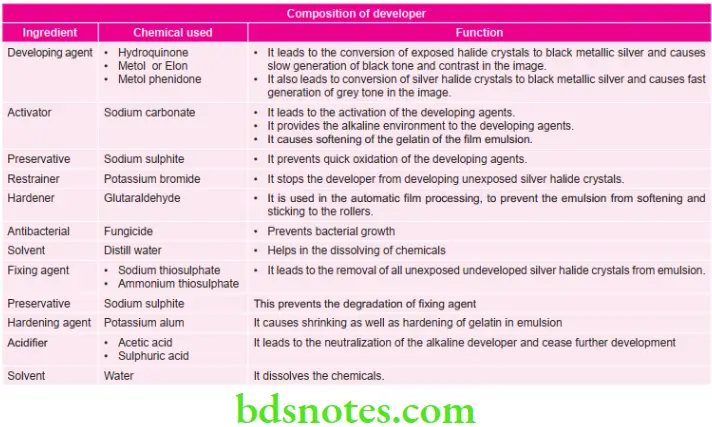
Question 2. Write short note on composition and function of fixer solution.
or
Write short note on composition of developer and fixer.
or
Describe compositions and functions of processing solutions.
or
Write short note on composition of developer solution.
Answer.
“Asymptomatic vs symptomatic effects of poor communication about X-ray film processing: Answered”
Leave a Reply