Primordial Cyst Of The Mandible
Question. Write a short note on primordial cyst.
Answer. It is the type of odontogenic cyst.
Recent concept: The term primordial cyst is not in use nowadays because it is considered to be an odontogenic keratocyst.
Primordial Cyst Clinical Features
- It is found in children and young adults between 10–30 years of age; it may persist in older age groups.
- It can arise in any portion ofthe jaw, mostly seen in the ascending ramus of the mandible in the third molar area.
- It enlarges painlessly and slowly replaces large portions of cancellous bone before expansion of cortical plates.
- Pain is associated with a large cyst caused by infection that may follow perforation of the expanded cortical plate.
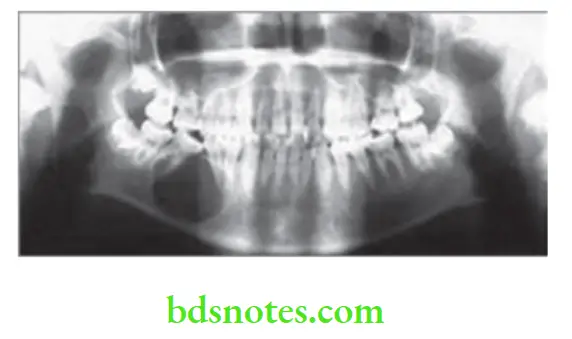
Primordial cyst of the mandible
Primordial Cyst Radiographic Features
- Cyst-like radiolucency that is well-defined and has hyperostotic borders.
- Internal structure is unilocular or has a scalloped outline, which gives the unilocular appearance.
- Teeth produce deflection of the adjacent tooth root, but seldom cause root resorption.
Primordial Cyst Differential Diagnosis
- Ameloblastoma: Occurs in old age. It is multilocular, but at times, it can be unilocular. It presents with paresthesia.
- Residual cyst: A History of tooth extraction is present.
- Traumatic cyst: The Margins of a traumatic cyst are scalloped, while the margins of a primordial cyst are hyperostotic.
- Giant cell granuloma: This is commonly present in the anterior part of the jaw.
- Giant cell lesion of hyperparathyroidism: It is ruled out based on serum investigations.
Unilocular radiolucency in the mandible
Primordial Cyst Management
- Surgical enucleation.
- Regular check-up due to high recurrence.
Leave a Reply