Potter-Bucky Diaphragm
Write a short note on the Potter-Bucky diaphragm.
Answer.
Potter-Bucky diaphragm
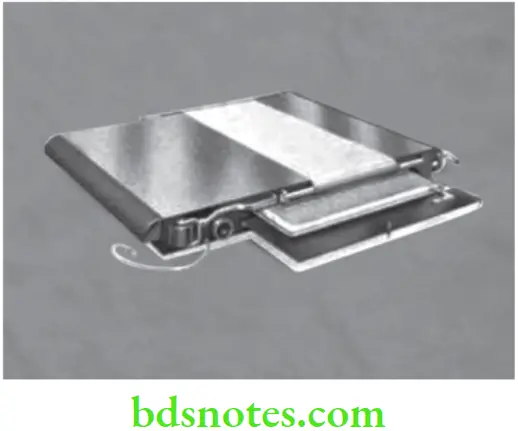
Potter-Bucky diaphragm is also known as the moving grid.
- It was discovered by Hollis E Potter in 1920.
- Potter-Bucky diaphragm is a moving grid which prevents scattered radiation from reaching to the film, and secures better contrast and definition.
- In this the grid is moved sideways across the film during exposure. This leads to blurring out of the shadows of grid strips, thus they are not visible on the film.
- Image of the radiopaque grid lines on the film can be deleted by mechanically moving the grid in a direction of 90° to the grid lines (but not the object) during exposure. This results in evening (blurring) out the radiolucent lines and resulting in a more uniform exposure.
“Steps to explain the function of the Potter-Bucky diaphragm: Grid movement vs filtration: Q&A guide”
- Potter-Bucky diaphragm eliminates most of the scatter while allowing most of the primary radiation through.
- Lead sheets cast a shadow on the image, and this is removed by moving the grid at the time of exposure.
- In older days, the shape of the diaphragm was curved, but nowadays the shape of the diaphragm is flat.
“Understanding the role of the Potter-Bucky diaphragm in radiography: Q&A explained”
“Importance of studying the Potter-Bucky diaphragm for better imaging outcomes: Questions explained”
Potter-Bucky diaphragm Advantages
- Removes the scattered radiation and decreases fog, as well as increases contrast.
- It eliminates white lead lines efficiently.
“Common challenges in using the Potter-Bucky diaphragm effectively: FAQs provided”
Potter-Bucky diaphragm Disadvantages
- It increases exposure time due to slow movement.
- It increases patient dosage.
- It can cause failure.
- It is costly.
Leave a Reply