Pneumococcus
Question 1. Write a short note on the identification of pneumococci
Answer:
Identification of pneumococci
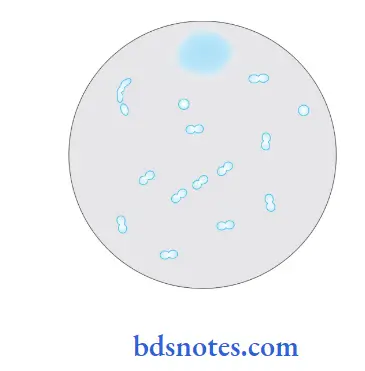
- It is gram-positive capsulated diplococci.
- It is usually 1 µ in diameter.
- Pneumococci are arranged in pairs, its broad ends are in opposition.
- It is flame shaped with elongated one broad end and the other end is pointed.
- It is non-motile and is non-sporing.
- The demonstration of the capsule is done by negative stain and quelling reaction.
- Negative stain, i.e. India ink: Capsule is seen as a clear halo around the bacteria.
- Quellung reaction: In this, capsule is seen as a refractile halo after mixing with the homologous type of specific antibody. Antibody gets combined by capsular polysaccharides.
- Negative stain, i.e. India ink: Capsule is seen as a clear halo around the bacteria.
“Understanding Streptococcus pneumoniae through FAQs: Q&A explained”
Read And Learn More: Microbiology Question And Answers
Question 2. Write a short note on gram-positive cocci.
Answer:
Gram-positive cocci are those that resist decolorization and retain primary stain-appearing violet.
Gram-positive cocci are:
- Streptococci
- Staphylococci
- Pneumococci
- Micrococcus
- Sarcinococcus.
1. Streptococci: They are gram-positive and are arranged in chains.
- They are non-motile and non sporing.
- The chain formation is due to cocci dividing in one plane.
- Streptococci are aerobic and facultative anaerobes.
“Importance of studying pneumococcus for microbiology students: Questions explained”
2. Staphylococci: They are important human pathogens that produce pyogenic infections. Spherical cocci are arranged characteristically in grapes like cluster. Staphylococcus are non-motile and nonsporing. A few strains possess visible capsules, else they are non-capsulated. Stain readily with aniline dyes, and are uniformly gram-positive.
3. Pneumococci: They are also responsible for non-suppurative lesion, acute rheumatic fever, and glomerulonephritis.
- They are gram-positive lanceolate diplococi.
- It is typically small, and slightly elongated with one end broad and other end is pointed (flame-shaped)
- It occurs in pairs, and capsulated.
- It is non-motile and non-sporing.
- In Indian pink preparation, the capsule appears as a clear halo.
“Role of polysaccharide capsule in pneumococcal virulence: Questions answered”
4. Micrococcus: They are gram-positive cocci that occur mostly in pairs, tetrads or irregular clusters.
- They are catalase and oxidase positive.
- They are aerobic.
- In cultures, they form smaller colonies.
- They are parasitic on mammalian skin.
5. Sarcinococcus: It is similar to micrococcus except that it forms of eight.
- Some of them are motile.
- It is mostly non-pathogenic.
“Common challenges in understanding pneumococcus effectively: FAQs provided”
Question 3. Write a short note on the morphology of gram-positive bacteria.
Answer:
Gram-positive cocci are those that resist decolorization and retain primary stain-appearing violet.
Gram-positive cocci are:
- Streptococci
- Staphylococci
- Pneumococci
- Micrococcus
- Sarcinococcus.
1. Streptococci: They are gram-positive and are arranged in chains.
- They are non-motile and non sporing.
- The chain formation is due to cocci dividing in one plane.
- Streptococci are aerobic and facultative anaerobes.
“Factors influencing success with pneumococcus knowledge: Q&A”
2. Staphylococci: They are important human pathogens that produce pyogenic infections. Spherical cocci are arranged characteristically in grapes like cluster. Staphylococcus are non-motile and nonsporing. A few strains possess visible capsules, else they are non-capsulated. Stain readily with aniline dyes, and are uniformly gram-positive.
3. Pneumococci: They are also responsible for non-suppurative lesion, acute rheumatic fever, and glomerulonephritis.
- They are gram-positive lanceolate diplococi.
- It is typically small, and slightly elongated with one end broad and other end is pointed (flame-shaped)
- It occurs in pairs, and capsulated.
- It is non-motile and non-sporing.
- In Indian pink preparation, the capsule appears as a clear halo.
“Steps to explain types of diseases caused by pneumococcus: Pneumonia vs meningitis vs otitis media: Q&A guide”
4. Micrococcus: They are gram-positive cocci that occur mostly in pairs, tetrads or irregular clusters.
- They are catalase and oxidase positive.
- They are aerobic.
- In cultures, they form smaller colonies.
- They are parasitic on mammalian skin.
5. Sarcinococcus: It is similar to micrococcus except that it forms of eight.
- Some of them are motile.
- It is mostly non-pathogenic.
Leave a Reply