• Skip to main content
  • Skip to secondary menu
  • Skip to primary sidebar
  • About Us
  • Terms of Use
  • Privacy Policy
  • Disclaimer
  • Contact Us
  • Sitemap

BDS Notes

BDS notes, Question and Answers

  • Public Health Dentistry
  • Periodontics
  • Pharmacology
  • Pathology
  • Orthodontics
    • Anchorage In Orthodontics
    • Mandibular Growth, Functional Matrix
    • Retention and Relapse
  • General Surgery
    • Cysts: Types, Causes, Symptoms
    • Maxillofacial Fractures, Disorders, and Treatments
    • Lymphatic Disorders
    • Neurological and Facial Disorders
  • Temporal And Infratemporal Regions
    • Spinal and Neuroanatomy
  • Dental Materials
    • Dental Amalgam
Home » Platelets

Platelets

July 26, 2025 by Kristensmith Taylor Leave a Comment

Platelets

“What are platelets? A detailed question and answers guide”

Question 1. Platelets.
Answer:

  • They are small, colourless, non-nucleated spherical, oval or rounded granular bodies.
  • Size: 2.5 m in diameter.
  • Normal count:
    • 2,50,000 (2,00,000 to 4,00,000)/cu mm of blood.
  • Properties: 3A’s
    • Adhesiveness
    • Aggregation Agglutination

“Understanding platelets through FAQs: Composition, functions, and uses explained”

Functions:

  1. Prevents blood looss
  2. Helps in blood coagulation by forming prothrombin activator.
  3. Helps in clot retraction as it contains contractile proteins.
  4. Contribute in repair of ruptured blood vessel.
  5. Stores 5-HT and histamine and release when needed.
    • Life-span: 10 days.

“Factors influencing success with platelet studies: Q&A”

Question 2. Prothrombin time.
Answer:

Definition:

  • The time taken by blood to clot after adding tissue thromboplastin is called prothrombin times.
  • It indicates the total quantity of prothrombin present in the blood.

Normal time-12 seconds:

Prolonged in:

  • Deficiency of prothrombin.
  • Deficiency of clotting factors I, V, VII and X

“Importance of studying platelets for medical students: Questions explained”

Question 3. Pro-coagulants.
Answer:

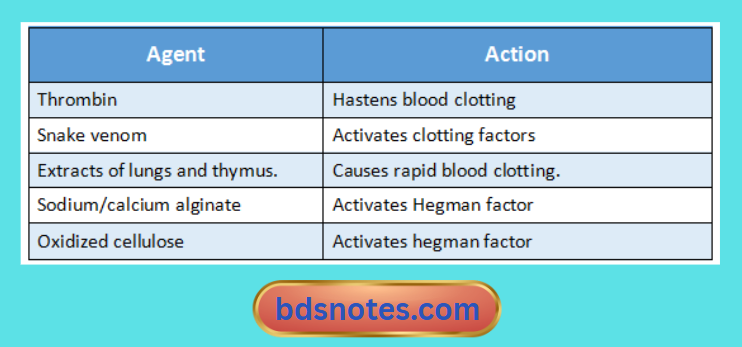
  • They are hemostatic agents which accelerate the process of blood coagulation.
  • They are:

Blood Procoagulants Table

“Common challenges in mastering platelet notes effectively: FAQs provided”

Question 4. Anticoagulants.
Answer:
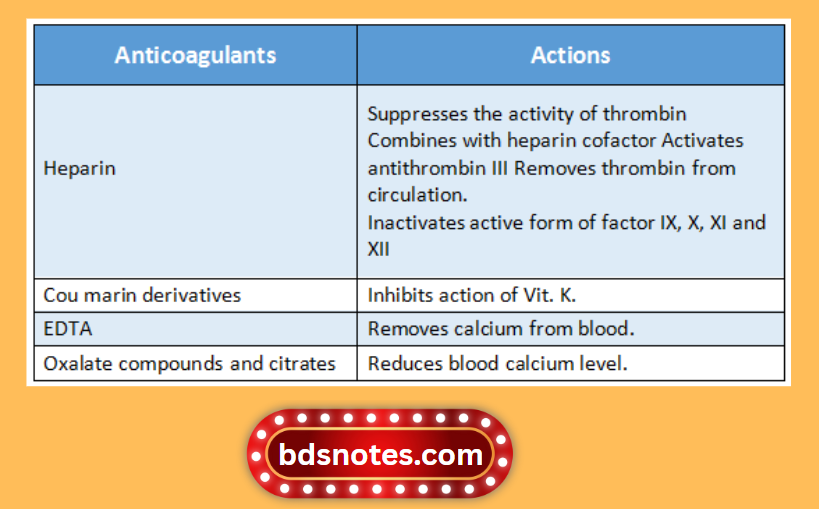
Blood Anticoagulants Table

Filed Under: Anatomy

Reader Interactions

Leave a Reply Cancel reply

Your email address will not be published. Required fields are marked *

Primary Sidebar

Recent Posts

  • Branchial Cleft Cyst: Background, Pathophysiology, Etiology
  • Maxillary Nerve: Origin, Course, And Branches
  • The Father Of Anatomy And A Great Anatomist Herophilus
  • Bone Structure – Anatomy
  • The External Carotid Artery: Anatomy, Branches, And Functions
  • Occipitofrontalis Muscle
  • Superficial Temporal Artery
  • Platysma Muscle
  • Cartilage
  • Cauda Equina And Conus Medullaris Syndromes
  • Subcutaneous Injections And Device Management
  • Types Of Circulation: Pulmonary, Systemic, And Portal
  • Structure Of Skeletal Muscle
  • Elastic Cartilage
  • Cellular Organelles And Structure
  • The Golgi Apparatus – The Cell
  • The Cytoplasmic Inclusions Of Certain Plant Cells
  • Dental Abscess
  • Laser Surgery
  • Our Facial Muscles And Their Functions

Copyright © 2026 · Magazine Pro on Genesis Framework · WordPress · Log in