Pit And Fissure Sealants
Question 1. Write briefly on pit and fissure sealants.
Or
Write a short note on pit and fissure sealants.
Answer.
Pit and fissure sealants are defined as cement or a resin which is introduced into unprepared occlusal pit and fissures of caries susceptible teeth forming a mechanical and physical protective layer against the action of acid producing bacteria and their substrates.
Types of Pit and Fissure Sealants
- The first generation sealants were achieved with an ultraviolet light source.
- The second generation sealants are auto-polymerizing.
- The third-generation sealants are photoinitiated with visible light.
- Another recent innovation is the fluoride-containing sealants.
“Understanding pit and fissure sealants: Uses and benefits”
Procedure of Pit and Fissure Sealant Application
- Polish the tooth surface: Remove all plaque and debris from the enamel and the pits and fissures of the tooth.
- Isolate and dry the tooth surface: Rubber dam provides the best isolation.
- Etch the tooth surface: 37 % of orthophosphoric acid is used for 15 to 30 seconds.
- Rinse the tooth: The Tooth should be rinsed for 15 seconds, rinsing all the etchant material from the tooth.
- Isolate and dry the tooth: The tooth should be dried with compressed air.
- Apply the bonding agent and cure it.
- Material application: Sealant material is then applied to the tooth, and be careful not to incorporate air bubbles in the material.
- Evaluate the sealant: Visually and tactically.
- Check occlusion: Occlusion is checked and adjusted if needed.
Read And Learn More: Public Health Dentistry Question And Answers
“Importance of sealants in public health dentistry”
Pit and Fissure Sealant Products
Today, we have several products that we can use as sealant materials.
- Unfilled sealants.
- Filled sealants.
- activated.
- Autopolymerizing.
- Fluoride releasing.
Pit And Fissure Sealants Indication
A deep occlusal fissure, fossa or a lingual pit.
Pit And Fissure Sealants Contraindications
- Open occlusal carious lesion.
- Caries exist on other surfaces of the same tooth.
- A large occlusal restoration is already present.
“Common applications of pit and fissure sealants explained”
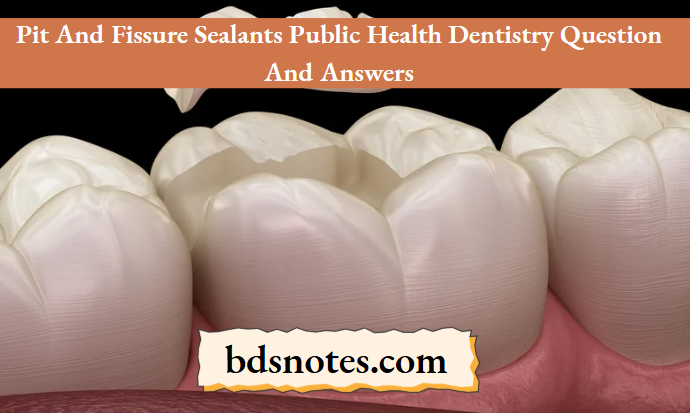
“Role of sealants in protecting molars from decay”
Question 2. Write a short answer on indications, contraindications, and classification of pit and fissure sealants.
Answer. Pit and fissure sealant is an organic polymer that flows into the pits and fissures and bonds to the enamel surface mainly by mechanical retention.
Pit And Fissure Sealants Indications
- A pit and fissure sealant is indicated for children and adults:
- Those who may be at moderate or high risk of developing dental caries, for many reasons.
- With incipient caries (limited to the enamel of pits and fissures).
- Those who have erupted permanent teeth with susceptible pits and fissures for dental caries.
- Those who have existing pits and fissures which have anatomically susceptible pits and fissures.
- Having a deep or irregular fissure, fossa, or pit is present, especially if it catches the tip of the explorer.
- In whom an intact occlusal surface is present, where the contralateral tooth surface is carious or restored.
“Pathophysiology of caries prevention with sealants explained”
Pit And Fissure Sealants Contraindications
A sealant is contraindicated if:
- Patient behavior does not permit the use of adequate dry field (isolation) techniques throughout the procedure.
- In an open occlusal carious lesion.
- Dental caries, particularly proximal lesions, exist on the other surface of the same tooth.
- A large occlusal restoration is already present.
- If pits and fissures are well coalesced and self-cleansing
- The life expectancy of a primary tooth is limited.
- When a patient is allergic to methacrylate.
“Treatment options using pit and fissure sealants”
Classification Of Pit And Fissure Sealants
- Based on generation
- Generation 1 sealant (photocured via UV light)
- Generation 2 sealant (auto or chemically-cured)
- Generation 3 sealant (photocured via visible light)
- Fluoride-containing sealants.
- Based on fillers
- Unfilled.
- Filled sealant
- Fluoride—Releasing.
“Role of sealants in comprehensive preventive care plans”
- Based on color
Helps in quick identification for evaluation during maintenance assessment:- Clear: Aesthetic but difficult to detect in follow-up
- Tinted/opaque sealant: Easy to detect.
- BIS-GMA versus non-BIS-GMA sealant.
Leave a Reply