Bone Bending And Piezoelectric Theory Of Tooth Movement
Write short note on piezoelectronic theories of tooth movement.
Answer.
- Farrar (l876) fist noted deformation or bending of the interseptal alveolar walls.
- According to Farrar bone bending may be a possible mechanism for bringing about tooth movement.
- Piezoelectricity is a phenomenon observed in many crystalline materials in which a deformation of crystal structure produces a flw of electric current because of displacement of electrons from one part of the crystal lattce to the other. A small electric current is generated when bone gets mechanically deformed.Possible sources of electric current are:
“Understanding the role of piezoelectricity in orthodontic tooth movement: Q&A explained”
- Collagen: Inside the bone, collagen occurs in crystalline state and so can be the source of piezoelectricity whenget deformed.
- Hydroxyapatite: It is crystalline in form and produce electricity when deformed.
- Collagen hydroxyapatite interface: It is the junction which lies between the collagen and hydroxyapatit crystals and when it is bent, it can be a source of piezoelectricity.
- Mucopolysaccharide: Fraction of ground substance is not crystalline but it may also possess the ability to generate electric current when get deformed.
- When crystal structure is deformed, the electrons migrate from one location to another which results in electric charge.
- When force is released, the crystals return to their original shape and a reverse flow of electrons is observed.
- Two unusual characteristics which piezoelectric signals possess are:
“Importance of studying piezoelectric theories for better orthodontic outcomes: Questions explained”
“Common challenges in applying piezoelectric theories effectively: FAQs provided”
- Quick decay rate: As force is applied, a piezoelectric signal is produced. This electric charge quickly dies away to zero even though the force is maintained.
- When the force is released, electron flow in the opposite direction is seen.
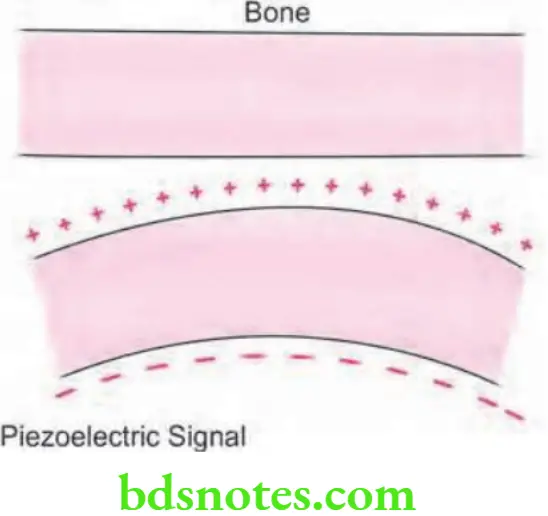
- On application of force on a tooth, the adjacent alveolar bone bends.
- Areas of concavity in bone associated with negative charge, these evoke bone deposition.
- Areas of convexity associated with positive charge evoke bone resorption.
“Steps to explain different piezoelectric theories in orthodontics: Stress-induced vs strain-induced: Q&A guide”
- On application of force on the tooth both alveolar and medullary cortical plates of bone move together closely and the bone becomes less concave and an electrical signal associated with the resorption get established.
- Bone which is deformed by stress get electrically charged. Concave surfaces attain negative polarity and convex surfaces a positive polarity.
- As a result of these electrical signals, a remodelling response is evoked; bone is added to concave surfaces and resorbed from convex surfaces.
“Role of mechanical stress in piezoelectric tooth movement: Questions answered”
Leave a Reply