• Skip to main content
  • Skip to secondary menu
  • Skip to primary sidebar
  • About Us
  • Terms of Use
  • Privacy Policy
  • Disclaimer
  • Contact Us
  • Sitemap

BDS Notes

BDS notes, Question and Answers

  • Public Health Dentistry
  • Periodontics
  • Pharmacology
  • Pathology
  • Orthodontics
    • Anchorage In Orthodontics
    • Mandibular Growth, Functional Matrix
    • Retention and Relapse
  • General Surgery
    • Cysts: Types, Causes, Symptoms
    • Maxillofacial Fractures, Disorders, and Treatments
    • Lymphatic Disorders
    • Neurological and Facial Disorders
  • Temporal And Infratemporal Regions
    • Spinal and Neuroanatomy
  • Dental Materials
    • Dental Amalgam
Home » Periodontal Disease

Periodontal Disease

November 19, 2025 by Kristensmith Taylor Leave a Comment

Periodontal Disease

Question 1. Discuss common chronic inflammatory conditions in relation to dental pathology.

Answer:

Chronic inflammation and degeneration of supporting tissues of teeth resulting in teeth loss is a common condition.

  • Inflammatory periodontal diseases affect adults more commonly.
  • Pregnancy, puberty and use of drugs like Dilantin are also associated with periodontal disease more often.
  • The disease begins as chronic marginal gingivitis, secondary to bacterial plaques around the teeth such as due to calculus on the tooth surface, impacted food, uncontrolled diabetes, tooth decay and ill-fitting dental appliances.
  • The gingival sulcus acts as a convenient site for the lodgment of food debris and bacterial plaque leading to the formation of periodontal pockets from which purulent discharge can be expressed by digital pressure.
  • Pathological Features: Chronic marginal gingivitis is characterized by heavy chronic inflammatory cell infiltrate, destruction of collagen and epithelial hyperplasia so as to line the pocket. Untreated chronic marginal gingivitis slowly progresses to chronic periodontitis or pyorrhea.

Periodontal disease treatment

Question 2. Discuss in briefly granulomatous inflammation.
Or
Write a short note on granuloma.
Answer:

Granulomatous Inflammation

Granulomatous inflammation is a distinctive pattern of chronic inflammatory reaction characterized by the presence of granulomas.

Granuloma is defined as a circumscribed tiny lesion, about 1 mm in diameter composed predominantly of a collection of modified macrophages called epithelioid cells and rimmed at the periphery by lymphoid cells.

Evolution of Granuloma
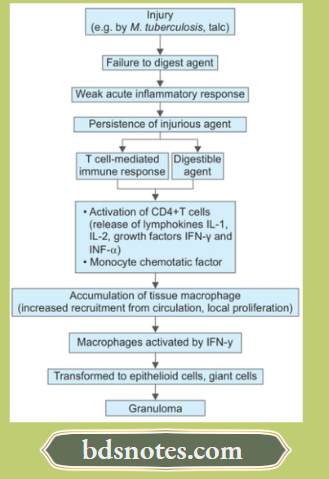
Inflammation Evolution Of Granuloma

Constituents of Granuloma

  • Epithelioid cells
  • Lymphoid cells
  • Giant cells
  • Necrosis
  • Fibrosis.

Periodontitis vs gingivitis

Examples of Granulomatous Inflammation

  • Tuberculosis
  • Syphilis
  • Leprosy
  • Fungal infection.

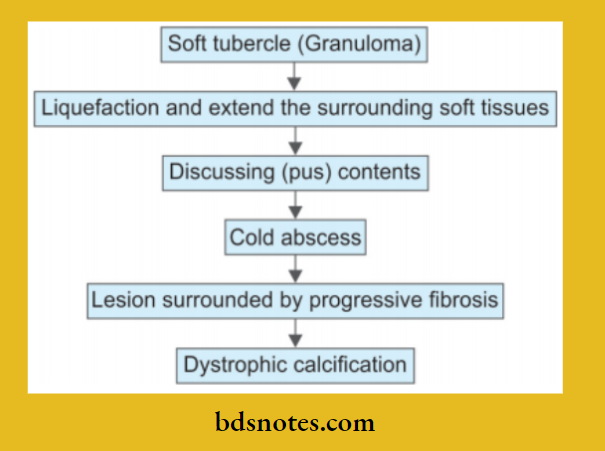
Fate of Granuloma

Inflammation Fate Of Granuloma

Filed Under: Pathology

Reader Interactions

Leave a Reply Cancel reply

Your email address will not be published. Required fields are marked *

Primary Sidebar

Recent Posts

  • Branchial Cleft Cyst: Background, Pathophysiology, Etiology
  • Maxillary Nerve: Origin, Course, And Branches
  • The Father Of Anatomy And A Great Anatomist Herophilus
  • Bone Structure – Anatomy
  • The External Carotid Artery: Anatomy, Branches, And Functions
  • Occipitofrontalis Muscle
  • Superficial Temporal Artery
  • Platysma Muscle
  • Cartilage
  • Cauda Equina And Conus Medullaris Syndromes
  • Subcutaneous Injections And Device Management
  • Types Of Circulation: Pulmonary, Systemic, And Portal
  • Structure Of Skeletal Muscle
  • Elastic Cartilage
  • Cellular Organelles And Structure
  • The Golgi Apparatus – The Cell
  • The Cytoplasmic Inclusions Of Certain Plant Cells
  • Dental Abscess
  • Laser Surgery
  • Our Facial Muscles And Their Functions

Copyright © 2026 · Magazine Pro on Genesis Framework · WordPress · Log in