Painless Jaw Swelling? Could It Be a Pleomorphic Adenoma
Write a note on the pleomorphic adenoma of the salivary gland.
Or
Write a short note on the mixed parotid tumor.
Or
Write a short note on pleomorphic adenoma.
Answer:
Pleomorphic Adenoma
Pleomorphic adenoma or benign mixed tumor is the most common neoplasm of salivary glands. The parotid gland is mostly affected by the tumor.
Pleomorphic adenoma Pathogenesis
- There is the presence of myoepithelial cells and reserve cells arranged in the intercalated duct.
- The intercalated duct reserve cells can differentiate into ductal and myoepithelial cells and the latter can then undergo mesenchymal metaplasia.
- Dardick’s theory: It is the most accepted theory. They state that a neoplastically altered epithelial cell with the potential for multidirectional differentiation may be histologically responsible for the pleomorphic adenoma.
Pleomorphic adenoma
“Understanding pleomorphic adenoma: Causes and symptoms”
Pleomorphic adenoma Clinical Features
- Pleomorphic adenoma develops in the 5th and 6th decade of life.
- It produces slow-growing, well-delineated exophytic growth of the salivary gland.
- The surface of the lesion is smooth and lobulated and generally, there is no pain.
- The neoplasm is usually soft or rubbery in consistency and is freely movable.
“Case studies on outcomes of pleomorphic adenoma surgery”
- The parotid gland lesion is usually superficial and often arises in the superficial lobe as a small mass overlying the angle of the mandible or anterior to the external ear.
- Sometimes, lesions can be multinodular and can assume an enormous size, especially in long-standing lesions.
- In buccal mucosa or lip pleomorphic adenoma presents small, painless, well-defied, movable nodular lesion with intact overlying mucosa.
“Importance of diagnosing painless jaw swelling early”
Pleomorphic adenoma Gross Features
- Pleomorphic adenoma is a circumscribed, pseudo encapsulated, rounded, at times multilobulated fim mass, 2 to 5 cm in diameter, with a bosselated surface.
- The Cut surface is grayish-white and bluish, variegated, semitranslucent, usually solid, and occasionally may show some cystic spaces. Consistency is soft and mucoid.
“Treatment options for pleomorphic adenoma in the jaw”
Pleomorphic adenoma Histopathology
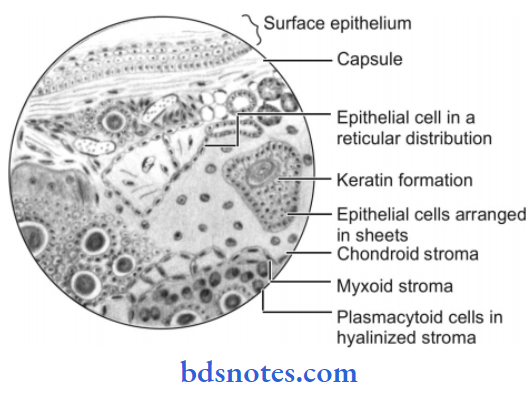
- The neoplasm often exhibits the proliferation of glandular epithelial cells in the form of diffuse sheets or clusters.
- The neoplastic cells are polygonal, spindle, or stellate in shape and have a tendency to form duct-like structures.
- The duct-like structures are of varying size, shape, and number and are widely distributed within lesions.
Salivary gland tumor
“Role of surgical excision in treating pleomorphic adenoma”
- Histologically, each duct-like structure exhibits an inner row of cuboidal or columnar cells and an outer row of spindle shape myoepithelial cells.
- The epithelial cells show “squamous metaplasia” and sometimes there may be the formation of keratin pearls by metaplastic epithelial cells.
- The connective tissue undergoes hyalinization to form structureless homogeneous material.
- A complete capsule is never present.
Leave a Reply