Habits
Question 1. Write a short note on tongue thrust habit.
Or
Write briefly on tongue thrusting habit.
Or
Write briefly on the management of tongue thrusting.
Answer. It is defined as the “placement of the tongue tip forward between incisors during swallowing”.
Classification of Tongue Thrusting
- Moyer’s Classification
- Simple tongue thrusting.
- Complex thrusting.
- Retained infantile swallow.
“Understanding the role of habits in orthodontic treatment: Q&A explained”
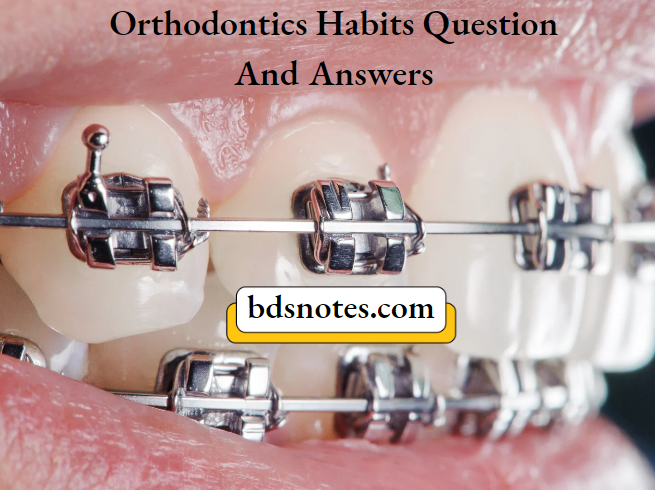
“Importance of studying orthodontic habits for better outcomes: Questions explained”
Read And Learn More: Orthodontics Question And Answers
- According to James S Braner and Holt
- Type 1: Non-deforming tongue thrust
- Type 2: Deforming anterior tongue thrust
- Subgroup 1: Anterior open bite
- Subgroup 2: Anterior proclination
- Subgroup 3: Posterior crossbite
- Type 3: Deforming lateral tongue thrust
- Subgroup 1: Posterior open bite
- Subgroup 2: Posterior crossbite
- Subgroup 3: Deep overbite
- Type 4: Deforming lateral and anterior tongue thrust
- Subgroup 1: Anterior and Posterior open bite
- Subgroup 2: Proclination of anterior teeth
- Subgroup 3: Posterior crossbite
“Common challenges in managing orthodontic habits effectively: FAQs provided”
Etiology of Tongue Thrust
Fletcher proposes the following factors as causes for tongue thrusting.
Genetic Factors
They are specific anatomic or neuromuscular variations in the orofacial region. For example, Hypertonic orbicularis oris activity.
Learned Behavior
- Tongue thrust can be acquired as a habit.
- Some predisposing factors of tongue thrusting are:
- Impropbottlette feeding.
- Prolonged thumb sucking.
- Prolonged tonsillar and upper respiratory tract infection A prolonged duration of tenderness of gum or teeth can result in a change in swallowing pattern to avoid pressure on the tender zone.
“Steps to explain different types of orthodontic habits: Thumb-sucking vs tongue thrusting: Q&A guide”
Maturational Factor
The infantile swallow changes to a mature swallow once the posterior deciduous teeth start erupting.
Sometimes, the maturation is delayed, and thus, infantile swallow persists for a longer duration of time.
Mechanical Restrictions
Such as macroglossia, constricted dental arches, or enlarged adenoids.
“Role of mouth breathing in orthodontic issues: Questions answered”
Neurological Disturbance
Neurological disturbances affecting the orofacial region, such as hypersensitive palate and moderate motor disability.
Psychogenic Factor
Tongue thrusting habits can develop due to the forced discontinuation of other habits, such as thumb sucking.
Clinical Features
Common Clinical Features of Tongue Thrusting Habit
- Proclination of the anterior teeth.
- Presence of bimaxillary protrusion
- Presence of anterior open bite
- In the lateral tongue thrust, there is a posterior open bite and posterior crossbite.
Simple Tongue Thrusting
- Normal tooth contact in the posterior region.
- Anterior open bite.
- Contraction of lips, mentalis muscle, and mandibular elevators.
- Posterior teeth show good intercuspation.
- Forward placement of the tongue in achieving anterior lip seal
“Early warning signs of issues caused by orthodontic habits: Common questions”
Complex Tongue Thrusting
- It is characterized by teeth apart swallow.
- An anterior open bite can be either diffuse or absent.
- Absence of temporal muscle constriction at the time of swallowing.
- Contraction of circumoral muscles at the time of swallowing.
- Occlusion of teeth can be poor.
Retained Infantile Swallow
- The jaw lies apart, and the tongue is placed between the gum pads.
- The mandible gets positioned.
- Lips and tongue guide the swallow.
Treatment/Management
Interception, as well as treatment of tongue thrusting, is always age and severity-dependent.
In young children whose age is 3 years, no intervention is needed, but children who are older than this age should be trained for tongue swallowing exercises.
Treatment of tongue thrusting is as follows:
Reminder Therapy/Interception of Habit
- Fixed and removable habit breakers, i.e., cribs and rakes, should be used. Removable appliances that can be used are up the per Hawley’s plate with tongue cribs and roller balls for tongue exercise.
- Teach the correct method of swallowing to the child.
“Asymptomatic vs symptomatic effects of ignoring orthodontic habits: Q&A”
Corrective Therapy
It consists of
- Obstruction removal
- Tongue exercises
- Lip exercises
- Habit breaking appliance
- Treatment of Malocclusion
Obstruction Removal
- Surgery should be done for the adenoid and macroglossia
- The anterior and posterior open bite should be closed by either a fixed or removable orthodontic appliance.
“Steps to educate patients about orthodontic habits and their importance: Q&A format”
Tongue Exercises
Some of the exercises of the tongue to adapt it to new swallowing patterns with removable or fixed orthodontic applianceareeis advised as a habit is intercepted. These are as follows:
- Elastic band swallow exercise: Held up the small orthodontic elastic band to the tongue tip against the palate during swallowing, and the patient should be asked to practice this. If the swallow is correct, the patient can hold the elastic; otherwise, it falls and can be swallowed.
- Water swallow exercise: Advise the patient to keep water in the mouth and a mirror in hand and practice swallowing daily.
- Candy swallow exercise: Place a flat sugarless candy between the tongue and the palate and practice swallowing. This exercise reinforces the learning of new swallowing patterns to be transferred to a subconscious level.
- Speech exercise: Syllables such as c, g, h, and k are practiced by the patient by keeping an elastic band between the tongue and the palate.
Lip Exercises
The patient practices the stretching of lips to achieve the anterior lip seal.
Habit Breaking Appliance
- Fabrication of the field tongue spike is done with 0.040-inch stainless steel alloy. The appliance is V-shaped with 3 to 4 projections extending to the cingulum of mandibular incisors and is soldered to molar bands or crowns. It should be placed in between 5 to 10 years of age.
- A modified tongue crib is used in patients with lateral tongue thrusting habits.
“Role of counseling in clarifying orthodontic habit goals for patients: Questions answered”
Treatment of Malocclusion
Treatment of malocclusion is carried out with either removable or fixed orthodontic appliances.
Question 2. Write a short note on the butterfly test.
Answer. It is also known as the cotton test or Massler’s butterfly test.
- The test is used to assess the difference between mouth breathing and nose breathing.
- A butterfly-shaped cotton piece is placed over the upper lip just below the nostrils.
- The breathing of the patient is observed.
- If cotton flutters down, it means the patient is a mouth breather. In this case, the test is positive.
- If cotton does not flutter down, it means the patient is a nasal breather. In this case, the test is negative.
Leave a Reply