Oral Lesions Of Syphilis
Question 1. Write a note on the reaction of the body to injury.
Answer:
Body response to injury is healing.
The process of healing involves:
1. Regeneration: When healing takes place by the proliferation of parenchymal cells and usually results in complete restoration of original tissues.
2. Repair: When the healing takes place by the proliferation of connective tissue elements, this result in firosis and scaring.
Two processes are involved in the repair:
- Granulation Tissue Formation
- Contraction of Wounds.
Oral lesions in syphilis
Granulation Tissue Formation
Granulation tissue is the proliferation of new small blood vessels that are slightly lifted on surface by a thin covering of fibroblasts and young collagen.
The following 3 phases are observed in the formation of granulation tissue:
- The phase of inflammation: Following trauma, blood clots at the site of injury. There is an acute inflammatory response with the exudation of plasma, neutrophils and some monocytes.
- The phase of clearance: Combination of proteolytic enzymes liberated from neutrophils, autolytic enzymes from dead Tissues cells, and phagocytic activity macrophages clear of the necrotic tissue, debris and blood cells.
- The phase of in the growth of granulation tissue: This phase consists of 2 main processes—angiogenesis or neovascularization and fibrogenesis
- Angiogenesis: The formation of new blood vessels at the site of injury takes place by the proliferation of endothelial cells from the margins of severed blood vessels.
Initially, the proliferated endothelial cells are solid buds but within a few hours develop a lumen and start carrying blood. The newly formed vessels are more Leaky accounting for the edematous appearance of new granulation tissue. Soon, these blood vessels differentiate into muscular arterioles, thin-walled venules and true capillaries. - Fibrogenesis: The newly formed blood vessels are present in an amorphous ground substance or matrix. The new fibroblasts originate from fibrocytes as well as by mitotic division of fibroblasts.
Some of these fibroblasts have a combination of morphologic and functional characteristics of smooth muscle cells known as myofibroblasts.
- Angiogenesis: The formation of new blood vessels at the site of injury takes place by the proliferation of endothelial cells from the margins of severed blood vessels.
Syphilis in oral cavity
Collagen fibrils begin to appear by about 6th day. As maturation proceeds, more and more of collagen is formed while the number of active fibroblasts and new blood vessels decreases. This results in the formation of an inactive-looking scar known as cicatrization.
Contraction of Wound
The wound starts contracting after 2-3 days and the process is completed by the 14th day. During this period, the wound is reduced by approximately 80% of its original size. Contracted wound results in rapid healing since a lesser surface area of the injured tissue has to be replaced.
Syphilitic chancre in mouth
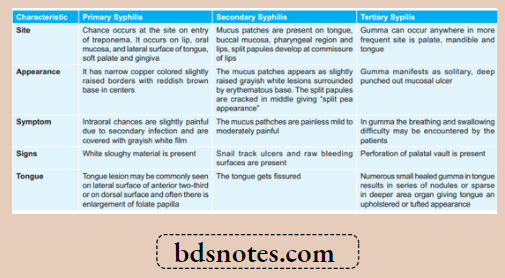
Question 2. Write a note on oral lesions of syphilis.
Answer:
Oral Lesions Of Syphilis
Leave a Reply