Optimum Force Magnitude For Orthodontic Tooth Movement
What are the various types of tooth movements. What do you understand by optimum force in orthodontics. Describe briefl mechanism of tooth movement.
Or
Write short answer on optimum orthodontic force.
Or
What is optimum orthodontic forces. Give detail about theories of tooth movement.
Answer.
Optimal Orthodontic Force in Orthodontics
“Factors affecting force magnitude in orthodontics”
- Oppenheim and Schwarz had discovered optimum orthodontic force.
- Optimal orthodontic force is one which moves teeth most rapidly in the desired direction, with the least possible damage to tissue and with minimum patient discomfort.”
- It is also known as ideal orthodontic force.
- Optimal orthodontic force should be less than capillary blood pressure.
- Range of optimal orthodontic force is 20–26 gm/cm² of root surface.
- According to Schwarz value of optimum orthodontic force for tooth movement is 15 to 20 mm Hg of capillary pressure.
- Clinically, optimal orthodontic force produces rapid tooth movement with minimum patient discomfort and minimum lag phase and there is no marked mobility of teeth being moved.
- Histologically, vitality of tooth and supporting periodontal ligament is maintained and this produces direct frontal resorption.
optimum force for tooth movement
“Understanding the role of force in orthodontic treatment”
Optimum Forces for Orthodontic Tooth Movement
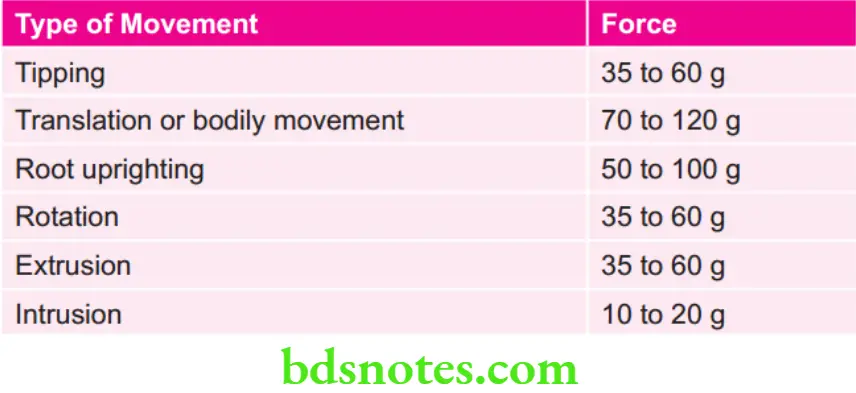
“Biomechanics of orthodontic tooth movement explained”
orthodontic tooth movement biomechanics
Advantages of Optimum Orthodontic Force
- Tooth movement is efficient.
- Resorption is of frontal type.
- There is elimination of lag phase and hyalinized zone.
- There is less pain and no damage to supporting structures.
- Chances for the root resorption are very less.
Leave a Reply