OPG Machine Principles
Draw a well-labeled diagram of OPG machine. discuss its principle of working.
or
Write in detail about principle of OPG machine
Answer.
Principle of Working of OPG Machine
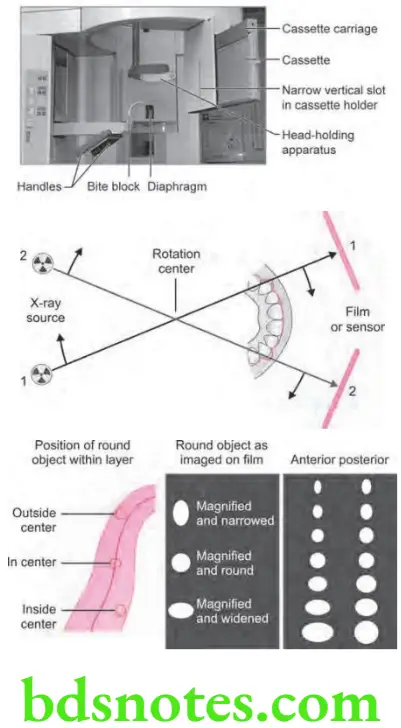
- If the film moves at the speed, which follows the moving projection of a certain point, this point will always be projected on the same spot on film and will not appear unsharp.
- In OPG, the film is attached to a rotating system and moves in opposite direction to the beam. The film is given correct speed by apposing this movement with contrary movement relative to the beam.
The Focal trough or image Layer
“Understanding the role of OPG machine principles in dental imaging: Q&A explained”
- It is defied as that zone which contains those object points which are depicted with optimum resolution in other words, it is a three-dimensional curved zone in which structures lying within are clearly demonstrated on a panoramic radiograph.
- In the OPG, the arches should be placed within the image layer.
- Image layer thickness, depends upon the effective projection radius and the width of the beam. The size and shape of the focal trough varies according to the manufacturer. The closer the rotation center to the teeth, narrower is the focal trough.
OPG machine principles
- In most machines, the focal trough is narrow in the anterior region and wide in the posterior region. Since the jaws are not circular, a variety of movement patterns for the beam have been developed.
“Importance of studying OPG machine principles for better imaging outcomes: Questions explained”
Rotation center
- In panoramic radiography, the film or cassette carrier and the tube head are connected and rotated simultaneously around a patient during exposure. The pivotal point or axis, around which the cassette carrier and X-ray tube head rotate is known as rotational center.
- Depending on the manufacturer, the number and location of the rotational centre differ:
- Single center of rotation: Dr. Paatero applied the principles of curved surface tomography, to relate to circular tomography, e.g. the rotagraph machine.
- Two centers of rotation: This follows the principle that, the individual lef and right sides of the arc formed by the teeth and jaws closely form a part of a circle. It was suggested that the center of rotation be positioned somewhat anteriorly to the location of the third molar opposite the side being examined. This double rotational principle was used in the Panorex machine.
“Common challenges in explaining OPG machine principles effectively: FAQs provided”
dental OPG machine
- Three centers of rotation—Three centers of rotation system divided the arc of the jaws into three areas:
- A condyle to fist bicuspid posterior segment
- A cuspid to cuspid anterior segment
- A contralateral-posterior segment.
- Three centers of rotation—Three centers of rotation system divided the arc of the jaws into three areas:
- These three curved segments have three different centers; two are bilaterally situated slightly posteromedial to the third molars, and the third is situated in the midline posterior to the incisors.
- The X-ray beam can be shifted from one center to the other without any interruption and a continuous image can be made from condyle to condyle, e.g. the orthopantomograph, panoram, panora.
dental panoramic machine
“Steps to explain different principles of OPG machines: Rotation vs stationary systems: Q&A guide”
- Moving Rotational Centers-Systems described so far have rotation centers or X-ray beams which were positioned at one or more fied locations during exposure. Pantomography is also achieved, if the beam rotates around a fied point or center.
- All these machines employ a moving rotational center that traces a path of the shape of an eclipse.
“Role of X-ray beam geometry in OPG machine principles: Questions answered”
orthopantomograph explanation
- Therefore, this system is also called “Ellipso pantomography”.
- In all cases, the center of rotation changes as the film and tube head rotate around the patient. The rotational change allows the image layer to conform to the elliptical shape of the dental arches. The location and number of rotational centers inflence the size and shape of the focal trough.
Leave a Reply