Odontoblastic Layer Explained: Cells, Functions, And Pulp Zones
Enumerate structures in the pulp. Write in detail about the odontoblastic layer and its function.
Answer:
Structure of pulp:
- It consists of
- Intercellular substance.
- Fibroblasts
- Fibers
- Undifferential mesenchymal cells.
- Odontoblasts.
- Defense cells.
- Blood vessels
- Lymph vessels.
- Nerves and nerve ending.
Odontogenic layer:
- Histologically four distinct zones are recognized they are.
- They are.
- Odontogenic layer
- Cell-free zone
- Cell-rich zone
- Pulp core
Odontogenic layer:
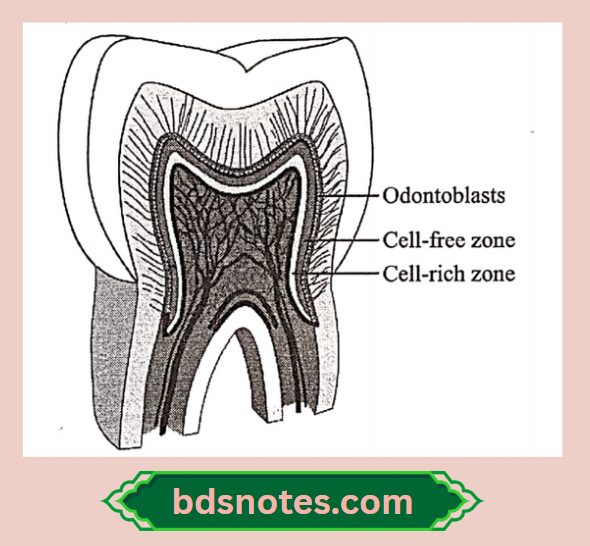
- It occurs adjacent to the prevention
- It consists of odontoblasts which are the second most prominent cell in the pulp after fibroblasts.
- These cells line the periphery of the pulp with their long axis at right angles to the pulp surface.
- The odontoblastic process extends into the dentinal tubules.
Number:
- The number of odontoblasts corresponds to the number of dentinal tubules.
- It ranges from 59,000 to 76,000 per square millimeter in coronal dentin to lesser in root dentin.
Shape:
- Odontoblasts in the crown are also larger than odontoblasts in the root.
- In the crown, they appear columnar, whereas in the midportion on the pulp, they are more cuboid, and in the apical part more flattened.
Nucleus:
- It is situated basally towards the pulpal side.
- It is oval in shape.
Cell organelles:
- Odontoblast has a prominent Golgi apparatus, abundant mitochondria, numerous vesicles, much endoplasmic reticulum, and numerous mitochondria scattered throughout the cell.
- The odontoblastic process contains no endoplasmic reticulum but during the active phase contains occasional mitochondria and vesicles.
Variation:
- The morphology of odontoblasts varies with their functional activity.
- Active cell:
- Appear elongated
- The nucleus is basally located
- Possess basophilic cytoplasm and prominent Golgi apparatus.
- Resting cell:
- It is stubby.
- Posses little cytoplasm.
- The nucleus is more hematoxyphilic.
Functions:
- Odontoblasts function primarily as secretory cells.
- They also secrete ground substances.
- They release inflammatory chemokine IL-8, chemotactic for neutrophils.
- Odontoblasts contain nitric oxide synthetase which plays an important role in vasodilation and blood pressure regulation.
Leave a Reply