• Skip to main content
  • Skip to secondary menu
  • Skip to primary sidebar
  • About Us
  • Terms of Use
  • Privacy Policy
  • Disclaimer
  • Contact Us
  • Sitemap

BDS Notes

BDS notes, Question and Answers

  • Public Health Dentistry
  • Periodontics
  • Pharmacology
  • Pathology
  • Orthodontics
    • Anchorage In Orthodontics
    • Mandibular Growth, Functional Matrix
    • Retention and Relapse
  • General Surgery
    • Cysts: Types, Causes, Symptoms
    • Maxillofacial Fractures, Disorders, and Treatments
    • Lymphatic Disorders
    • Neurological and Facial Disorders
  • Temporal And Infratemporal Regions
    • Spinal and Neuroanatomy
  • Dental Materials
    • Dental Amalgam
Home » Neurophysiology Short Notes: Reflex Action, Spinocerebellar Tracts, And Nerve Conduction

Neurophysiology Short Notes: Reflex Action, Spinocerebellar Tracts, And Nerve Conduction

February 6, 2026 by Kristensmith Taylor Leave a Comment

Neurophysiology Short Notes: Reflex Action, Spinocerebellar Tracts, And Nerve Conduction

Question 1. Define reflex action and describe Babinski sign

Answer:

Reflex action:

  • It is the response to a peripheral nervous stimulation that occurs without our consciousness.

Babinski’s sign:

  • It is an abnormal plantar reflex
  • It is elicited by a gentle scratch over the outer edge of the sole of the foot
  • In normal plantar reflex it causes flexion and adduction of all toes
  • In Babinski’s sign there is dorsiflexion of great toe and fanning of other toes
  • It is present in
    • Upper motor neuron lesion
    • Infancy
    • Deep sleep

Question 2. Give the origin and termination of spinocerebellar tracts. Add a note on its functions.
Answer:
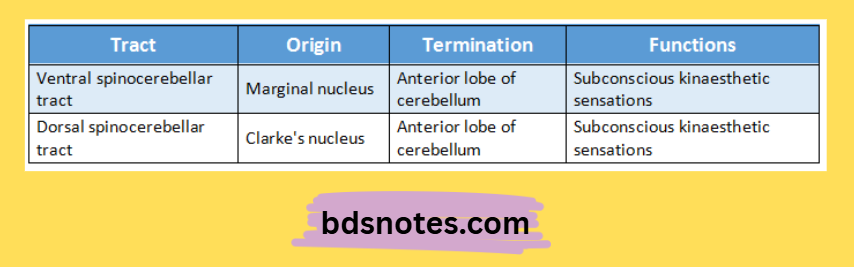
Spinocerebellar Tracts Origin Termination

Question 3. What is saltatory conduction? Describe the classification of nerve fibres according to the rate of nerve conduction.
Answer:

Saltatory conduction:

  1. Myelin sheath is impermeable to ions
  2. Thus, sodium enter into nerve fibres from ECF only in the node of Ranvier and depolarisation occurs
  3. Depolarisation occurs in successive nodes and action potential thus, jumps from one node to another node
  4. This jumping is called saltatory conduction.

Classification of nerve fibres depending upon rate of conduction:

  • Type A nerve fibres
    • Type A alpha- conduction velocity is 70-120 m/sec
    • Type A beta-conduction velocity is 30-40 m/sec
    • Type A gamma – conduction velocity is 15-30 m/sec
    • Type A delta – conduction velocity is 12-30 m/sec
    • Type B nerve fibres – conduction velocity is 3-20 m/sec
    • Type C nerve fibres
      1. Subtype 1-conduction velocity is 0.5-2 m/sec
      2. Subtype 2-conduction velocity is 0.7-2.3 m/sec

Filed Under: Anatomy

Reader Interactions

Leave a Reply Cancel reply

Your email address will not be published. Required fields are marked *

Primary Sidebar

Recent Posts

  • Branchial Cleft Cyst: Background, Pathophysiology, Etiology
  • Maxillary Nerve: Origin, Course, And Branches
  • The Father Of Anatomy And A Great Anatomist Herophilus
  • Bone Structure – Anatomy
  • The External Carotid Artery: Anatomy, Branches, And Functions
  • Occipitofrontalis Muscle
  • Superficial Temporal Artery
  • Platysma Muscle
  • Cartilage
  • Cauda Equina And Conus Medullaris Syndromes
  • Subcutaneous Injections And Device Management
  • Types Of Circulation: Pulmonary, Systemic, And Portal
  • Hierarchical Organization Of Skeletal Muscle Tissue
  • Elastic Cartilage Histology Short Note For Medical Exams
  • Cellular Organelles And Structure
  • The Golgi Apparatus – The Cell
  • The Cytoplasmic Inclusions Of Certain Plant Cells
  • Dental Abscess
  • Laser Surgery
  • Our Facial Muscles And Their Functions

Copyright © 2026 · Magazine Pro on Genesis Framework · WordPress · Log in