Neuromuscular Physiology: Linking Nerve Signals To Muscle Action
Question 1. Neuromuscular transmission.
Answer:
- It includes following steps:
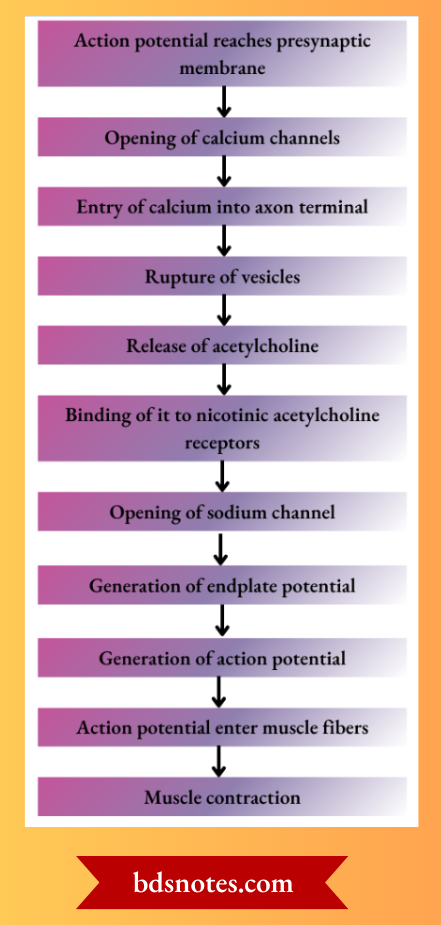
Question 2. Isotonic and isometric contraction:
Answer:
1. Isotonic contraction:
- In this type of muscular contraction, the length of the muscle changes while the tension remains constant.
- The muscle is allowed to shorten and lift a load.
- Example: Moving legs in walking.
2. Isometric contraction:
- In this type of muscular contraction, the length of the muscle remains same while the tension is increased.
- Muscle is not allowed to shorten.
- Example: Pulling of any heavy object.
Question 3. Frank starling’s law.
Answer:
- It states that the force of contraction of muscle is directly proportional to its initial length.
- Larger the initial length, greater will be the force of contraction.
Frank starling’s law Lamination:
- As the muscle is stretched the developed tension increases to a maximum and then declines as stretch becomes more extreme.
Frank starling’s law Significance:
- It is applicable to cardiac muscle.
- Thus, it helps to explain the blood ejected by each of the ventricle per heart beat.
Leave a Reply