Neurilemmoma
- Neurilemmoma is also known as schwannoma.
Neurilemmoma is a benign neural neoplasm of Schwann cell origin.
Neurilemmoma Clinical Features
- The lesion occurs most commonly in young and middle age adults.
- Neurilemmoma is a slow growing encapsulated tumor which arises in association with nerve trunk.
- Usually the tumor mass is asymptomatic, but tenderness or pain is present if tumor is causing pressure in associate nerves.
- Tumor may range from few millimeters to several centimeters in size.
neurilemmoma
“Importance Of Early Detection Of Neurilemmoma”
Neurilemmoma Oral Manifestations
- It occurs commonly in oral cavity and the most common site of occurrence is tongue.
- The lesion is a single, circumscribed nodule of varying size which presents no pathognomonic features.
- Neurilemmoma also occur as central lesion in the mandible and arises from mandibular nerve.
- Centrally occurring lesion may lead to destruction of bone with expansion of cortical plates.
- Pain and paresthesia is common in centrally occurring lesions.
“Risk Factors For Developing Neurilemmoma”
Neurilemmoma Histopathology
- Usually, the lesion presents two types of histologic patterns, i.e. Antoni A and Antoni B pattern.
“Understanding The Role Of Schwann Cells In Neurilemmoma”
- Antoni A: This pattern is made up of the cells which have spindle shape or elongated nuclei which are aligned to form a characteristic palisaded pattrn and the intercellular fiers are arranged in parallel fashion between rows of nuclei. In some areas, these fiers show arrangement in shape of whorls or swirls. In the palisaded arrangement of cells around central acellular area eosinophilic areas are seen known as Verocay bodies.
- Antoni B: In this pattrn, there is disordered arrangement of spindle cells and fiers in loose myxomatous stroma with areas of edema flid and formation of microcysts.
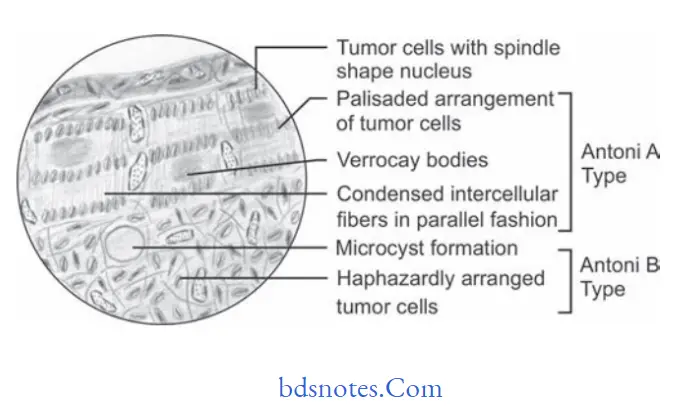
schwannoma
“Early Signs Of Neurilemmoma In Nerves”
Neurilemmoma Treatment
Surgical excision is the treatment of choice.
Leave a Reply