Nasopharynx: Definition, Structure And Function
Write a short note on the nasopharynx.
Answer.
Nasopharynx is the upper portion of pharynx lying behind the nasal cavities with which it communicates. Internally it is lined by mucous membrane.
Nasopharynx Boundaries
The roof and lateral wall are formed by the body of the sphenoid which forms a continuous sloping surface, and the basilar part of the occipital bone.
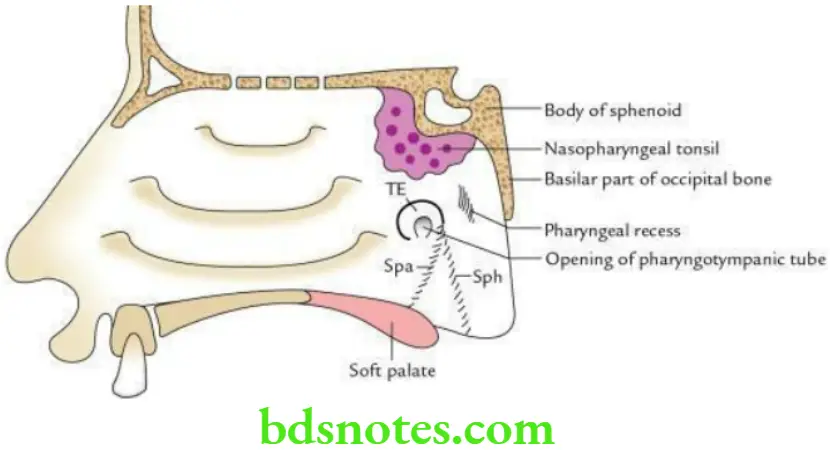
The floor is formed by the sloping upper surface of the soft palate.
Floor Features
- The presence of the nasopharyngeal tonsil at the junction of the roof and posterior wall, deep to the mucous membrane, is more prominent in children. When enlarged it is called as adenoid.
- Pharyngeal opening of pharyngotympanic tube which maintains the equilibrium of air pressure on both sides of the tympanic membrane.
- The tubal tonsil is an aggregation of lymphoid tissue along the upper and posterior margin of the tubal opening deep into mucous membrane producing elevation called tubal elevation.
- Salpingopharyngeal and salpingopalatine folds. Out of these two folds, one extends downwards towards the wall of pharynx enclosing salpingopharyngeus muscle and is called the salpingopharyngeal fold, while the other extends downwards and forward to the soft palate enclosing the levator palati muscle and is called salpingopalatine fold.
- The pharyngeal recess is a depression behind the tubal elevation.
Leave a Reply