• Skip to main content
  • Skip to secondary menu
  • Skip to primary sidebar
  • About Us
  • Terms of Use
  • Privacy Policy
  • Disclaimer
  • Contact Us
  • Sitemap

BDS Notes

BDS notes, Question and Answers

  • Public Health Dentistry
  • Periodontics
  • Pharmacology
  • Pathology
  • Orthodontics
    • Anchorage In Orthodontics
    • Mandibular Growth, Functional Matrix
    • Retention and Relapse
  • General Surgery
    • Cysts: Types, Causes, Symptoms
    • Maxillofacial Fractures, Disorders, and Treatments
    • Lymphatic Disorders
    • Neurological and Facial Disorders
  • Temporal And Infratemporal Regions
    • Spinal and Neuroanatomy
  • Dental Materials
    • Dental Amalgam
Home » Mucogingival Surgery

Mucogingival Surgery

February 9, 2026 by Kristensmith Taylor Leave a Comment

Mucogingival Surgery

What are indications for mucogingival surgery? Describe apically displaced flap surgery.
Answer. Mucogingival surgery refers to periodontal surgical procedures designed to correct defect in morphology, position and/or amount of gingiva surrounding the teeth.

Mucogingival Surgery Indications

  • Augmentation of edentulous ridge.
  • Prevention of ridge collapse associated with tooth extraction.
  • Crown lengthening.
  • Loss of interdental papilla which presents as esthetic/phonetic defect.

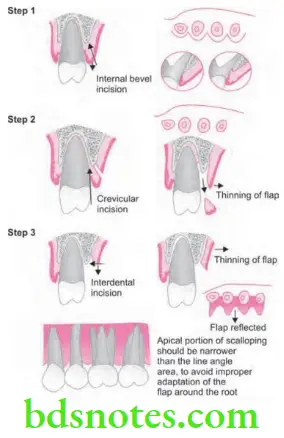
Apically Displaced Flap Surgery

Used for both pocket irradiation and widening of zone of attached gingiva:

  • Step 1: Internal bevel incision is made 1 mm from the crest of the gingiva and directed towards the crest of the bone.
  • Step 2: Crevicular incision is made followed by initial elevation of flap and than interdental incision is performed, the wedge of the tissue containing the pocket wall is removed.
  • Step 3: Vertical releasing incisions are made extending beyond the mucogingival junction. If objective is full thickness flap, then it is elevated by blunt dissection with periosteal elevator. If split thickness flap is required, then it is elevated by sharp dissection using bard parker knife to split it.
  • Step 4: Remove all the granulation tissue, root planing is done and flap is displaced apically at the tooth bone junction.
  • Step 5: If a full thickness flap was performed, then a sling suture around the tooth prevents the flap from sliding to a position more apical than that desired, and the periodontal dressing can avoid its movement in a coronal direction. A partial thickness flap is sutured to the periosteum using a direct loop suture or a combination of loop and anchor sutures. Place a dry foil over the flap before covering it with dressing to prevent the introduction of pack under the flap.
Periodontics Periodontal Flap Apically displaced flap surgery

Filed Under: Periodontics

Reader Interactions

Leave a Reply Cancel reply

Your email address will not be published. Required fields are marked *

Primary Sidebar

Recent Posts

  • Branchial Cleft Cyst: Background, Pathophysiology, Etiology
  • Maxillary Nerve: Origin, Course, And Branches
  • The Father Of Anatomy And A Great Anatomist Herophilus
  • Bone Structure – Anatomy
  • The External Carotid Artery: Anatomy, Branches, And Functions
  • Occipitofrontalis Muscle
  • Superficial Temporal Artery
  • Platysma Muscle
  • Cartilage
  • Cauda Equina And Conus Medullaris Syndromes
  • Subcutaneous Injections And Device Management
  • Types Of Circulation: Pulmonary, Systemic, And Portal
  • Structure Of Skeletal Muscle
  • Elastic Cartilage
  • Cellular Organelles And Structure
  • The Golgi Apparatus – The Cell
  • The Cytoplasmic Inclusions Of Certain Plant Cells
  • Dental Abscess
  • Laser Surgery
  • Our Facial Muscles And Their Functions

Copyright © 2026 · Magazine Pro on Genesis Framework · WordPress · Log in