Middle Meningeal Artery
The middle meningeal artery arises from first part of the maxillary artery in the infratemporal fossa deep to lateral pterygoid muscle.
- The artery ascends upwards and enters into middle cranial fossa through foramen spinosum.
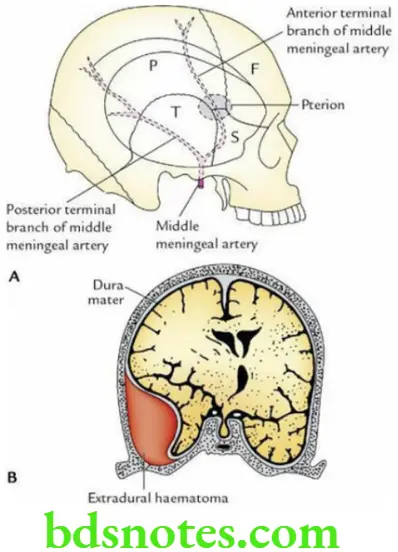
- On entering the cranial cavity, it lies in the groove deep to corresponding vein and divides into anterior (frontal) and posterior (parietal) terminal branches.
“Understanding the anatomy and function of the middle meningeal artery through FAQs: Q&A explained”
The larger anterior branch ascends crossing the greater wing of sphenoid in a groove just deep to the pterion of lateral wall of skull. Then it runs obliquely upwards and backwards parallel to and little in front of central sulcus, on precentral gyrus.
- The smaller posterior branch runs backwards over the superior temporal sulcus of cerebrum about 4 cm above the zygomatic arch.
Middle Meningeal Artery Branches
“Importance of studying the middle meningeal artery for medical students: Questions explained”
Predominantly, middle meningeal artery is periosteal artery which supplies bone and red marrow within the dipole.
Within the cranial cavity it gives rise to the following branches:
- Anterior branch supplies dura mater and skull bones in the frontal region of skull.
- Posterior branch supplies dura mater and skull bone in the parietal region.
- Ganglionic branches to trigeminal ganglion.
- Petrosal branch enters the hiatus of greater petrosal nerve to supply facial nerve.
- Superior tympanic branch to supply tensor tympani muscle.
- Temporal branches pass through foramina in the greater wing of sphenoid to enter in the temporal fossa.
- Anastomotic branch which anastomoses with the recurrent meningeal branch of lacrimal artery.
“Common challenges in understanding middle meningeal artery anatomy effectively: FAQs provided”
Middle Meningeal Artery Applied anatomy
Middle meningeal artery is the commonest source of extradural haemorrhage. Fractures on the lateral side of skull involving pterion tear the middle meningeal artery (anterior branch) producing extradural haematoma lying over premotor area of cerebral cortex. This leads to pressure symptoms, e.g. contralateral hemiplegia. Hence, extradural haematoma is an acute surgical emergency.
“Factors influencing success with middle meningeal artery knowledge: Q&A”
Leave a Reply