• Skip to main content
  • Skip to secondary menu
  • Skip to primary sidebar
  • About Us
  • Terms of Use
  • Privacy Policy
  • Disclaimer
  • Contact Us
  • Sitemap

BDS Notes

BDS notes, Question and Answers

  • Public Health Dentistry
  • Periodontics
  • Pharmacology
  • Pathology
  • Orthodontics
    • Anchorage In Orthodontics
    • Mandibular Growth, Functional Matrix
    • Retention and Relapse
  • General Surgery
    • Cysts: Types, Causes, Symptoms
    • Maxillofacial Fractures, Disorders, and Treatments
    • Lymphatic Disorders
    • Neurological and Facial Disorders
  • Temporal And Infratemporal Regions
    • Spinal and Neuroanatomy
  • Dental Materials
    • Dental Amalgam
Home » Microtome Explained: The Tool Behind Ultra-Thin Tissue Sections

Microtome Explained: The Tool Behind Ultra-Thin Tissue Sections

February 6, 2026 by Kristensmith Taylor Leave a Comment

Microtome Explained: The Tool Behind Ultra-Thin Tissue Sections

Question 1. Preparation of the ground section of the tooth.
Answer:

  • The labial surface of the tooth is ground down till the desired section is achieved using a coarse abrasive wheel.
  • The coarse wheel is exchanged with the fine abrasive wheel.
  • The tooth is further ground.
  • An adhesive tape is wrapped around a wooden block with a sticky side outward.
  • The grounded section of the teeth is stuck to it.
  • A similar grinding procedure is repeated from the lingual surface.
  • The finished ground section is soaked off with ether.
  • It is then dried off for several minutes
  • Longer drying leads to cracking.
  • It is then mounted on microscopic slides.

Question 2. Microtome
Answer:

  • It is a tool used to cut extremely thin slices of material, known as sections
  • Used for preparation of samples

Blades used:

Microtome Blade Types And Uses

Applications:

  • Traditional histological examination
  • For frozen sections
  • For electron microscopy
  • For spectroscopy
  • For fluorescence microscopy

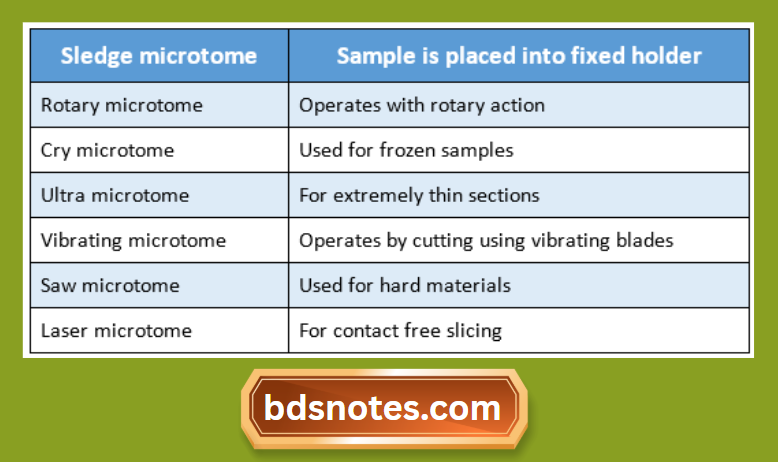
Types:

Types Of Microtomes And Their Uses

Microtome knives:

  1. Planar concave extremely sharp
  2. Wedge-shaped More stable
  3. Chisel shaped Has blunt edge

Filed Under: Anatomy

Reader Interactions

Leave a Reply Cancel reply

Your email address will not be published. Required fields are marked *

Primary Sidebar

Recent Posts

  • Branchial Cleft Cyst: Background, Pathophysiology, Etiology
  • Maxillary Nerve: Origin, Course, And Branches
  • The Father Of Anatomy And A Great Anatomist Herophilus
  • Bone Structure – Anatomy
  • The External Carotid Artery: Anatomy, Branches, And Functions
  • Occipitofrontalis Muscle
  • Superficial Temporal Artery
  • Platysma Muscle
  • Cartilage
  • Cauda Equina And Conus Medullaris Syndromes
  • Subcutaneous Injections And Device Management
  • Types Of Circulation: Pulmonary, Systemic, And Portal
  • Structure Of Skeletal Muscle
  • Elastic Cartilage
  • Cellular Organelles And Structure
  • The Golgi Apparatus – The Cell
  • The Cytoplasmic Inclusions Of Certain Plant Cells
  • Dental Abscess
  • Laser Surgery
  • Our Facial Muscles And Their Functions

Copyright © 2026 · Magazine Pro on Genesis Framework · WordPress · Log in