Metyrapone
Question 1. Write A Short Note On Metyrapone.
Answer:
Metyrapone is a glucocorticosteroid.
- Mechanism of action: It inhibits 11 β hydroxylases in the adrenal cortex and prevents hydrocortisone → increased ACTH release → increase excretion of 11. desoxycortisol in urine.
- In pituitary disease, urinary excretion of 11. desoxycortisol fails to increase in response to metyrapone administration.
- Thus, it is used to test the responsiveness of the pituitary and its ACTH-producing capacity.
- It has also been used in the treatment of Cushing’s syndrome due to adrenal tumors or ectopic ACTH-producing tumors.
Question 2. Write On Glucocorticoids—Two Names, Main Actions, And Toxicity.
Answer:
Glucocorticoid is a corticosteroid and it is secreted from the adrenal cortex.
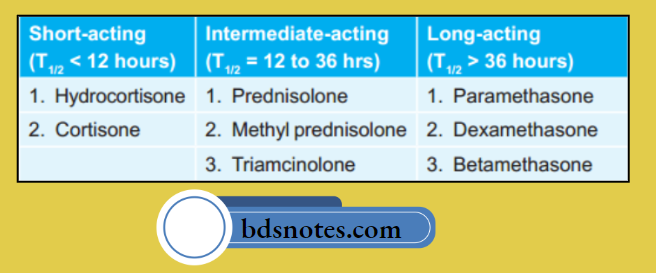
Classification Of Glucocorticoids
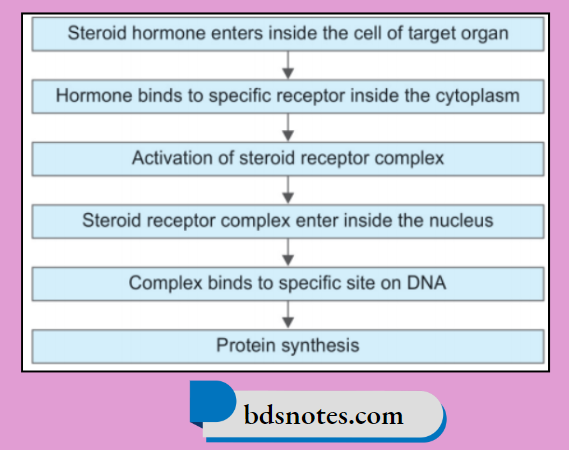
Glucocorticoids Mechanism Of Action
Glucocorticoids Action
- Carbohydrate metabolism: It promotes glycogenesis, and gluconeogenesis and decreases glucose utilization by peripheral tissues.
- Lipid metabolism: Chronic use of glucocorticoids leads to the redistribution of body fats.
- Protein metabolism: Glucorticoids lead to the breakdown of protein and mobilization of amino acids from muscle, skin, bone, etc. This leads to osteoporosis, thinning of the skin, growth retardation, etc. Wound healing and fibrosis are also inhibited.
- Electrolyte and water metabolism: Glucocorticoids have weak mineralocorticoid action which leads to retention of both sodium and water and increases excretion of potassium. So chronic use of these drugs leads to edema and hypertension.
- Calcium metabolism: Glucocorticoids cause inhibition of calcium absorption from the gut and increase renal excretion of calcium which causes a decrease in blood calcium level. This causes osteoporosis and pathological fracture of vertebral bodies.
- Cardiovascular system: Glucocorticoids lead to the retention of sodium and water and create pressure acting on adrenaline and angiotensin. Long-term use of drugs can cause hypertension and worsening of congestive heart failure.
- Skeletal muscle: Glucocorticoids are required for normal muscle activity. Long-term use of glucocorticoids can cause muscle wasting as well as weakness.
- Central nervous system: Glucocorticoid therapy may lead to euphoria, insomnia, restlessness, and psychosis.
- Gastrointestinal tract: Glucocorticoid inhibits the secretion of prostaglandins which causes an increase in gastric acid and aggravates a peptic ulcer. Glucocorticoids also decrease the local immune response against H. pylori which increases the chances of peptic ulcer.
- Anti-inflammatory effect: They suppress inflammatory response thus they decrease capillary permeability, exudation, central infiltration, and phagocytic activity, and thus the sign of inflammation are reduced.
- Immunosuppressant effect: Glucocorticoids provide an immunosuppressant effect that causes inhibition of both B cell and T cell lymphocyte functions which leads to impairment of humoral and cell-mediated immunity.
Leave a Reply