Methods Of Gaining Space
Question 1. Enumerate various methods of gaining space. Describe in detail therapeutic extractions.
Answer.
Enumeration of Methods of Gaining Space
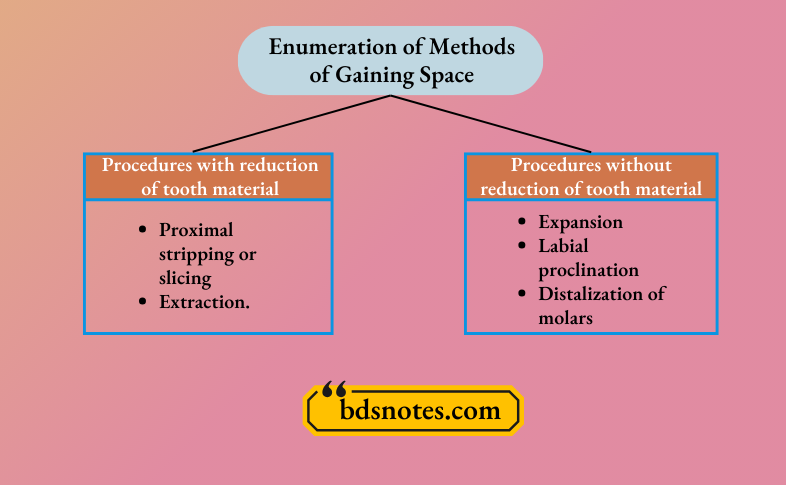
“Understanding the role of space gaining methods in orthodontic treatment: Q&A explained”
Question 2. What are the various considerations in extraction of teeth in orthodontics. Discuss the extraction of incisor teeth in detail.
Answer.
Extraction of Incisor Teeth
Extraction of incisor teeth is divided on the basis of incisors in upper arch and incisors in lower arch.
“Importance of studying space gaining methods for better orthodontic outcomes: Questions explained”
Extraction of Upper Incisors
Upper incisors are very rarely indicated for the extraction in orthodontics. There are some of the conditions where a single or more maxillary incisors may have to be extracted. Some of the conditions are:
“Role of interproximal reduction (IPR) in gaining space: Questions answered”
- An unfavorable impacted maxillary incisor which cannot be fitted into the normal occlusion.
- Buccally or lingually blocked lateral incisor with nice contact between central incisor and canine may be extracted.
- If a congenitally missing lateral incisor is present the opposite side lateral incisor should be extracted.
- Grossly carious incisor which cannot be restored.
- Malformed incisors which cannot be restored.
- Trauma to incisor by fracture.
- Incisor with dilacerated root.
“Factors influencing the effectiveness of space gaining methods: Q&A”
Extraction of Lower Incisors
Extraction of mandibular incisors should be avoided.
Extraction of mandibular incisor is done to relieve lower anterior crowding causes narrowing of mandibular intercanine width, mandibular incisors become retroclined, deep bite and again crowding. This causes collapse of mandibular arch.
“Steps to explain different methods of gaining space in orthodontics: Extraction vs non-extraction: Q&A guide”
There are some of the conditions where mandibular incisors are extracted:
- If one of the incisor is completely out of the arch with good interproximal contacts of other teeth.
- A traumatized mandibular incisor which had undergone dental caries, gingival recession or bone loss should be extracted.
- If severe arch length deficiency is present it causes fanshaped flaring of mandibular incisor crowns. In these cases extraction of single incisor tooth is done which improves crowding and axial inclination of other incisors.
- In mild class 3 malocclusion cases where mandibular incisor crowding is present. Mandibular incisor should be extracted for achieving normal overjet, overbite and also to relieve crowding.
- In cases with tooth size discrepancy.
- In treatment of class 1 cases with moderate mandibular lower labial segment crowing to 5 mm. This is treated with extraction of mandibular incisor.
Leave a Reply