• Skip to main content
  • Skip to secondary menu
  • Skip to primary sidebar
  • About Us
  • Terms of Use
  • Privacy Policy
  • Disclaimer
  • Contact Us
  • Sitemap

BDS Notes

BDS notes, Question and Answers

  • Public Health Dentistry
  • Periodontics
  • Pharmacology
  • Pathology
  • Orthodontics
    • Anchorage In Orthodontics
    • Mandibular Growth, Functional Matrix
    • Retention and Relapse
  • General Surgery
    • Cysts: Types, Causes, Symptoms
    • Maxillofacial Fractures, Disorders, and Treatments
    • Lymphatic Disorders
    • Neurological and Facial Disorders
  • Temporal And Infratemporal Regions
    • Spinal and Neuroanatomy
  • Dental Materials
    • Dental Amalgam
Home » Mesiodens And Its Impact On Eruption And Alignment

Mesiodens And Its Impact On Eruption And Alignment

July 12, 2025 by Joankessler parkland Leave a Comment

Mesiodens And Its Impact On Eruption And Alignment

Question 1. Write short note on mesiodens.

Answer. Mesiodens is a supernumerary tooth in maxillary anterior incisor region.

“Common challenges in diagnosing mesiodens effectively: FAQs provided”
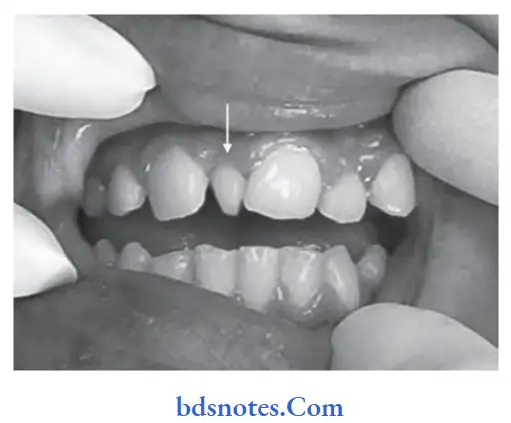
Developmental Disturbances of Oral and Para oral Structures Mesiodens

“Understanding the role of mesiodens in dental alignment: Q&A explained”

  • Mesiodens represents one of the more common supernumerary teeth and can erupt spontaneously.
  • Mesiodens supernumerary tooth was classifid according to its location, i.e. it is located at or near to midline in incisal
    region of maxilla between the central incisors.
  • According to the shape and size, two subclasses are considered in the classifiation of mesiodens; namely, eumorphic and dysmorphic.
    The eumorphic subclass is usually similar to a normal­sized central incisor, whereas the dysmorphic teeth have diffrent shapes and sizes and are categorized into conical, tuberculate, supplemental and odontomes.
    Out of these conical form is most common type.

“Importance of studying mesiodens for better orthodontic outcomes: Questions explained”

  • Mesiodens may be seen as an isolated fiding or as part of a syndrome, specially cleft lip and palate, cleidocranial dysostosis and Gardner’s syndrome.
  • Mesiodens can occur either as single tooth or it is paired.
    It can be impacted or inverted.
  • Mesiodens is a small tooth consisting of cone shaped crown and short root.
  • Mesiodens can lead to retarded eruption, displacement or resorption of adjacent root.
  • Mesiodens can frequently cause improper alignment.
  • It usually results in oral problems such as malocclusion,food impaction, poor esthetics, and cyst formation.
  • Immediate removal of mesiodens is usually indicated in the following situations; inhibition or delay of eruption,displacement of the adjacent tooth, interference with orthodontic appliances, presence of pathologic condition, or spontaneous eruption of the supernumerary tooth.

Filed Under: Oral Pathology

Reader Interactions

Leave a Reply Cancel reply

Your email address will not be published. Required fields are marked *

Primary Sidebar

Recent Posts

  • Branchial Cleft Cyst: Background, Pathophysiology, Etiology
  • Maxillary Nerve: Origin, Course, And Branches
  • The Father Of Anatomy And A Great Anatomist Herophilus
  • Bone Structure – Anatomy
  • The External Carotid Artery: Anatomy, Branches, And Functions
  • Occipitofrontalis Muscle
  • Superficial Temporal Artery
  • Platysma Muscle
  • Cartilage
  • Cauda Equina And Conus Medullaris Syndromes
  • Subcutaneous Injections And Device Management
  • Types Of Circulation: Pulmonary, Systemic, And Portal
  • Structure Of Skeletal Muscle
  • Elastic Cartilage
  • Cellular Organelles And Structure
  • The Golgi Apparatus – The Cell
  • The Cytoplasmic Inclusions Of Certain Plant Cells
  • Dental Abscess
  • Laser Surgery
  • Our Facial Muscles And Their Functions

Copyright © 2026 · Magazine Pro on Genesis Framework · WordPress · Log in