Managing Bleeding Disorders in Dental Practice: A Clinical Overview
Question. Write a short note on Bleeding Disorders in Dental Practice.
Or
Write a short note on bleeding disorders.
Answer. Bleeding disorders: Bleeding disorders or hemorrhagic diatheses are a group of disorders characterized by defective hemostasis with abnormal bleeding.
Bleeding disorders
Idiopathic Thrombocytopenic Purpura
Idiopathic Thrombocytopenic Purpura Etiology
- Impaired platelet production
- Accelerated platelet destruction
- Splenic sequestration
- Dilution loss
Managing Bleeding Disorders in Dental Practice
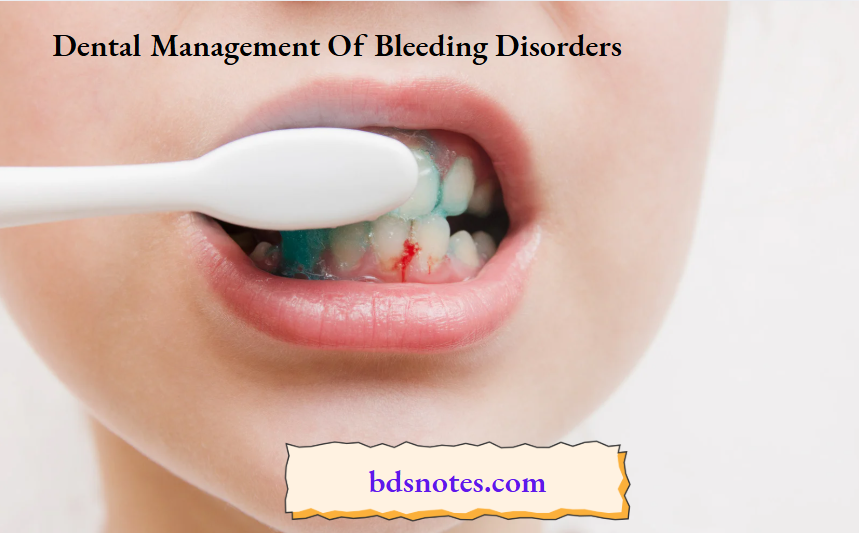
Idiopathic Thrombocytopenic Purpura Oral Manifestations
- Excessive bleeding after tooth extraction.
- Extensive spontaneous gingival bleeding may be seen.
- Petechiae do not blench on pressure
Idiopathic Thrombocytopenic Purpura Management
- Corticosteroids that is prednisolone 60 mg/dL.
- Splenectomy, if there is no response to prednisolone to prednisolone in 3–4 days.
- Local hemostatics.
Bleeding Disorders and Dental Treatment

Hemophilia Etiology
Hereditary coagulation disorder occurring due to qualitative or quantitative defects in von Willebrand factor.
Hemophilia Oral Manifestations
- Gingival bleeding and postextraction bleeding
- Disease may be discovered after dental extraction.
Hemophilia Management
- Mild episodes of bleeding can be treated with desmopressin which increases vWF level which leads to secondary increase in Factor VIII.
- For more serious bleeds during dental procedure hemostasis is achieved by Factor VIII concentrate which contain considerable quantities of vWF in addition to factor VIII.
Hereditary Hemorrhagic telangectasia
It is transmitted as autosomal dominanttraitand is characterized by bleeding from mucous membrane.
Hereditary Hemorrhagic telangectasia Management
- In patient having repeated attcks of epistaxis septal dermoplasty should be done. In septal dermoplasty,involved mucosa get removed and skin grafting is done.
- If spontaneous hemorrhages are present or nasal bleeding is present during dental procedure, it is controlled by giving pressure packs.
- Sclerosing agents, i.e. sodium tetradecyl sulphate if injected intra lesionally stop bleeding.
- Electrocautery is done. It helps in arresting bleeding.
Disseminated Intravascular Coagulation
It is a condition that results when the clottng system is activated in all or a major part of vascular system.
Despite widespread firin production the major clinical problem is bleeding not thrombosis.
Disseminated intravascular coagulation (DIC) is associated with a number of disorders such as infection, obstetric complications, cancer and snakebite.
Clinical Management of Bleeding Disorders in Dentistry
Disseminated Intravascular Coagulation Management
- Correction of hemodynamic instability by flid therapy,transfusion of packed cells or whole blood.
- Factor replacement: This is the specifi therapy, in this freshfrozen plasma, cryoprecipitate, platelet concentrate transfusions are essential. Freshfrozen plasma is given at the dose of 15 mL/kg. Platelet is transfused at the dosage of 0.1 unit/kg.
Leave a Reply