Lungs And Gas Exchange: Understanding Diffusion Factors
Describe factors determine oxygen uptake in lung.
Answer:
Factors determining oxygen uptake in lungs:
1. Pressure gradient:
- Uptake of oxygen by the blood in the lungs in mainly favoured by oxygen pressure gradient.
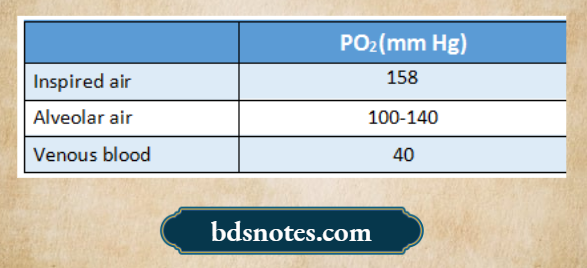
- Thus, because of this pressure gradient. O2 rapidly diffuses from alveoli through the thin pulmonary and capillary endothelium into the plasma.
2. Thickness of respiratory membrane:
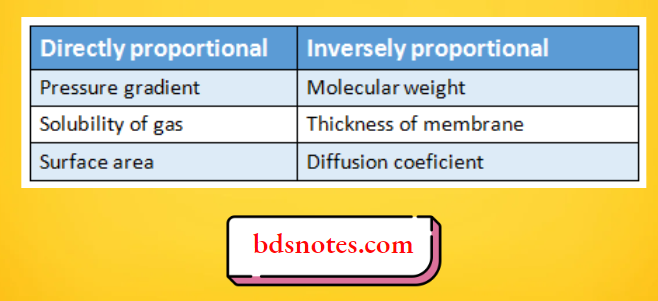
- Diffusion is inversely proportional to the thickness of respiratory membrane.
- In pulmonary fibrosis or edema, the thickness of respiratory membrane increases due to collection of fluid in the membrane.
- This decreases the diffusion.
3. Surface area:
- Diffusion of gases is directly proportional to the surface area of the respiratory membrane.
- During block in pulmonary capillary, the surface area of the membrane decreases.
- During exercise, surface area increases and thus diffusion of O2 also increases.
4. Solubility of gas:
- Diffusion of O2 is directly proportional to the solubility of gas.
- If the solubility of a gas is more in the fluid medium, a large number of molecules are available or diffusion.
- So, diffusion also increases.
5. Molecular weight of the gas:
- Diffusion of gas is inversely proportional to its molecular weight.
- If the molecular weight is more the density is more and diffusion is less.
6. Diffusion coefficient:
- It is defined as a constant, which is the measure of a dissolved substance diffusing through the concentration gradient.
- It reduces when the molecular size of the diffusing substance is increased.
- Thus, the smaller molecules diffuses rapidly than the large ones.
Relation between diffusion and its factors:
Leave a Reply