Lipoproteins And Its Functions
Classify lipoproteins with their functions.
Answer.
Lipoproteins Definition
- Lipoproteins are molecular complexes that consist of lipids and proteins.
- They are conjugated proteins and they function as transport vehicles for lipids in the blood.
Lipoproteins and Their Functions: Types and Roles in the Body
Structure Of Lipoproteins
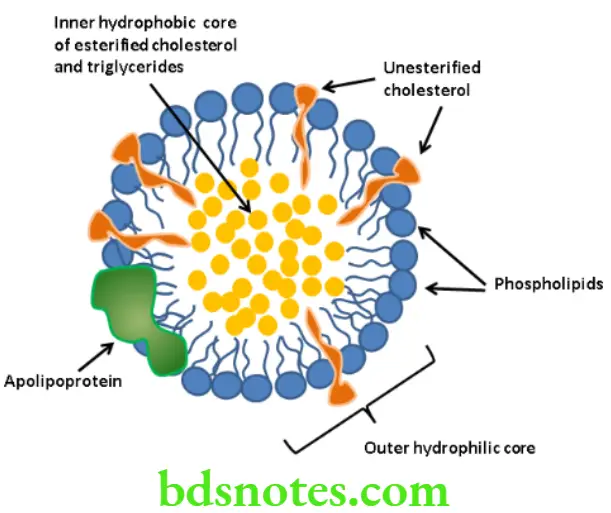
- A lipoprotein consists of a neutral lipid core (triglyceride and cholesterol ester), surrounded by a shell of phospholipid, apoprotein and cholesterol.
- The phospholipid and cholesterol are exposed on the surface of the lipoprotein so that the lipoprotein is soluble in aqueous solution
Classification Of Lipoproteins
Lipoproteins can be classified by two methods:
- Ultracentrifugation
- Electrophoresis
Functions of Lipoproteins: HDL, LDL, VLDL, and Chylomicrons
Classification By Ultracentrifugation
By ultracentrifugation lipoproteins are classified as:
- Chylomicrons – density lowest – floats
- VLDL
- LDL
- HDL – density highest, sinks to the bottom (settles below)
Lipoproteins and Their Role in Cholesterol Transport and Metabolism
Functions Of Lipoproteins
Chylomicrons
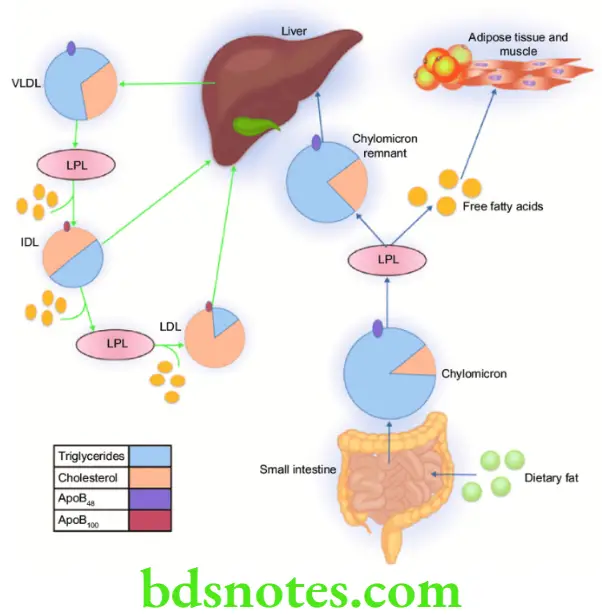
- Chylomicrons are synthesised in the intestinal mucosal cells
- They transport the exogenous triglycerides (triglycerides taken in the diet) from the intestine to the liver.
VLDL
- VLDL are synthesised in the hepatic cells
- VLDL transport the endogenous triglyceride (triglyceride synthesised in the body) from the liver to the peripheral tissues
HDL and LDL Lipoproteins: Functions in Cardiovascular Health
IDL
- VLDL is acted upon by the enzyme lipoprotein lipase which removes the triglycerides, to from IDL (intermediate density lipoprotein).
- IDL loses some more triglyceride to form LDL
- LDL is formed by the degradation of VLDL
- LDL is very rich in cholesterol and cholesterol ester and poor in triglyceride
- LDL transports cholesterol from the liver to the peripheral tissues
- This is known as forward transport of cholesterol
- Excessive deposition of cholesterol by LDL in the blood vessels can cause atherosclerosis; hence LDL is called BAD cholesterol
Lipoproteins and Their Impact on Lipid Metabolism and Absorption
HDL
- HDL is synthesised in the liver
- HDL transports cholesterol from the peripheral tissues to the liver, where the cholesterol is degraded
- This movement of cholesterol by HDL is called reverse transport of cholesterol
- Since HDL helps in reducing blood cholesterol level, it is called GOOD cholesterol
Leave a Reply