Intrinsic Pathway Of Blood Coagulation
Question 1. Name two bleeding disease how are they caused?
Answer:
Bleeding disease:
1. Hemophilia:
- It is a sex linked inherited diseases characterized by prolonged clotting time.
Hemophilia Causes:
- Hemophilia occurs due to lack of formation of prothrombin activator.
- Causes differs according to its type.
Hemophilia A:
- It is caused due to deficiency of factor VIII of coagulation.
Hemophilia B:
- It is caused due to deficiency of factor IX of coagulation.
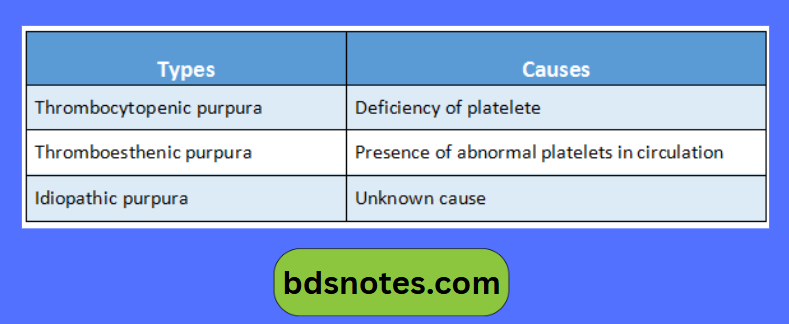
2. Purpura:
- It is a bleeding disorder characterized by prolonged bleeding.
- Types and Its causes:
3. Von villebrand Disease:
- It is a bleeding disorder characterized by excessive bleeding even after a mild injury.
Von villebrand Disease Causes:
- It occurs due to deficiency of von wilebrand factor.
- This suppresses platelet adhesion.
- It also causes deficiency of factor VIII.
Question 2. Hemostasis:
Answer:
Hemostasis Definition:
- Arrest of bleeding is called hemostasis.
Hemostasis Stages:
1. Vasoconstriction:
- It includes the constriction of blood vessels to decrease the blood flow and prevent its loss.
- When blood vessel is cut, collagen gets exposed from the damaged endothelium of the vessel.
- The platets adhere to this collagen and gets activated and secrete contractile substances to cause vasoconstriction.
- This adherence of platelets is facilitated by von Willebrand factor and platelet activating factor.
2. Formation of Platelet plug:
- The platelet that are adhere to the exposed collagen secrete ADP and thromboxane A2.
- These attract more and more platelets which aggregate to form and temporary loose platelet plug.
- This closes the vessel and prevents further blood loss.
3. Coagulation of blood:
- Fibrinogen gets converted into fibrin.
- This fibrin gets attached to the loosely formed platelet plug.
This is then modified by fibrin stabilizing factor and calcium ions to form a meshwork. - Thus, this is how blood loss in prevented after formation of blood clot.
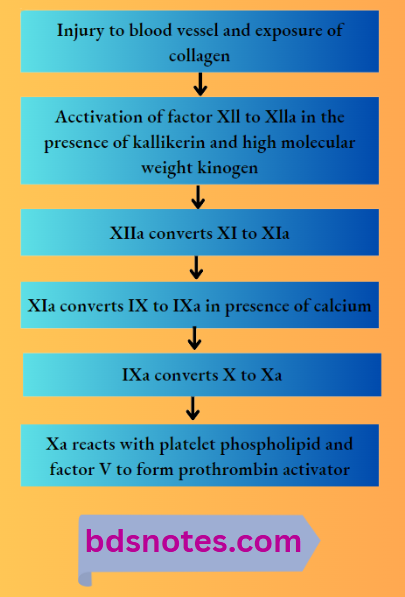
Question 3. Describe intrinsic pathway of blood coagulation.
Answer:
Intrinsic mechanism of clotting:
Leave a Reply