Interceptive Orthodontics
Write short note on interceptive orthodontics.
Answer. It is defined as “that phase of science and art of orthodontics employed to recognize and eliminate potential irregularities and malpositions in developing dentofacial complex”.
Interceptive procedures are the measures undertaken to prevent the potential malocclusion from progressing to more severe one.
“Understanding the role of interceptive orthodontics in early treatment”
Procedures undertaken in interceptive orthodontics are:
- Serial extractions
- Correction of developing crossbite: anterior and posterior
- Control of abnormal habits
- Space regaining
- Muscle exercises
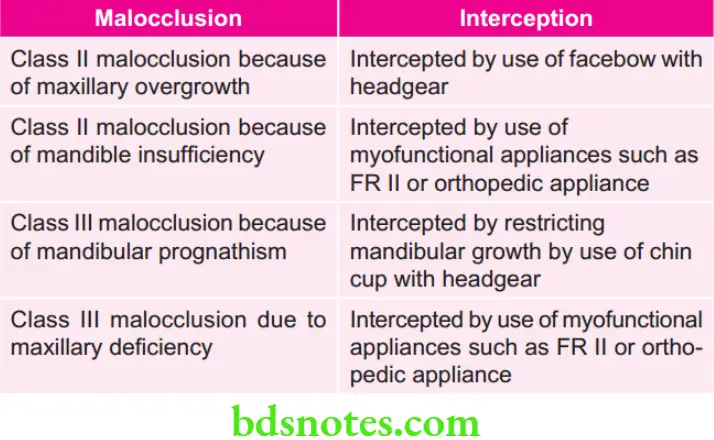
- Interception of skeletal malrelation
- Removal of soft tissue or bony barrier to enable the eruption of teeth
- Extraction of supernumerary or ankylosed teeth
“Importance of studying interceptive orthodontics for better outcomes”
Serial Extractions
- It is an interceptive orthodontic procedure which consists of planned extraction of certain deciduous teeth and later on the specific permanent teeth in orderly sequence and predetermined pattern to guide the erupting permanent teeth at their most favorable position.
- Three of the popular methods in serial extraction are Dewel’s method, Tweed’s method and Nance method.
- Dewel’s method is the popular methods of all the above given methods.
- Following is the Dewel’s method. It is a three-step procedure:
- Step 1: Extraction of deciduous canine to create space for alignment of the incisors (8-9 years of age).
- Step 2: Extraction of deciduous fist molar to accelerate the eruption of fist premolar (one year later).
- Step 3: Extraction of erupting fist premolar to permit the permanent canine to erupt.
“Common challenges in applying interceptive orthodontics effectively”
Correction of Developing Crossbite
Anterior crossbite should be intercepted and treated at an early stage, if lef untreated it can cause severe skeletal malocclusion. Dentoalveolar anterior crossbites are best treated by tongue blade therapy. Skeletal anterior crossbites are best treated by myofunctional appliances. Functional anterior crossbite is treated by eliminating occlusal prematurities.
Control of Abnormal Habits
- Habit refers to the certain action involving the teeth and various other oral and perioral structures which are repeated enough by some patients to have profound and deleterious effect on position of teeth and occlusion.
- Some of the effects which affect the oral structures are thumb sucking, tongue thrusting and mouth breathing.
- Thumb sucking: It is the most frequently practiced habit by the children and causes damage to dentoalveolar structures. Presence of this habit upto 21/2 to 3 years of age is quite normal. If this habit remains till 31/2 to 4 years, it can damage the dentoalveolar structures and should be intercepted. This habit is intercepted by using habit breakers which are of removable type or the one which is fixed.
- Tongue thrust: It is defied as the condition in which tongue make contact with any teeth anterior to molars during swallowing. It leads to open bite and anterior proclination. This habit should be intercepted by habit breakers. Patient should be trained and educated over the correct technique of swallowing.
- Mouth breathing: This has profound effect on dentofacial region. It affects orofacial equilibrium due to lowered mandibular and tongue posture and therefore produce severe malocclusion. Here interceptive procedure consists of identification and removal of the cause. If oral habitual breathing persists vestibular screen is used to intercept the habit.
“Steps to explain different types of interceptive orthodontic treatments”
Space Regaining
Space regaining should be done at early age before eruption of second molar.
This can be done by using following appliances, i.e:
- By using cantilever spring: Space lost due to mesial drifting of permanent molar as well as distal drifting of deciduous first molar when deciduous molar get lost prematurely, this is regained by use of two finger springs.
- By using jack screw: Space is regained by use of removable orthodontic appliance which has jack screw in a way which increases the arch length which is obtained by distalization of molar.
- Gerber space regainer: It is an orthodontic molar band which is used for the tooth which has to be distalized. It consists of a U shaped hollow tubing.
“Role of space maintainers in interceptive orthodontics: Questions answered”
Muscle Exercises
Presence of the normal orofacial muscle function is very essential for the development of normal occlusion.
These aberrant muscle functions are improved by various muscle exercises:
- Exercise for masseter muscle strengthening: Ask the patient to clench the teeth and count to 10 and now relax and repeat this over some period of time.
- Exercise for lips and cheeks: Ask the patient to hold a piece of paper between lips which maintain the lip seal by stretching the upper lip, holding and swishing the water behind the lips.
- Exercises for the tongue: For this there is one elastic and two elastic swallow. Hold pull exercise and tongue hold exercise is done.
Main limitation of these muscle exercises is that they are not the substitute for the corrective orthodontic therapy, and of they are not done correctly, they can be counterproductive also.
“Early warning signs of issues addressed by interceptive orthodontics”
Interception of Skeletal Malrelation
They are treated by taking the advantage of growth potential of an individual and using the myofunctional appliances and orthopedic appliances such as head gears and chin cups.
“Asymptomatic vs symptomatic effects of untreated interceptive orthodontic cases”
Removal of Soft Tissue and Bony Barrier
It involves excision of soft tissue as well as removal of bone covering the crown of unerupted tooth for making the space so that tooth can erupt easily.
Extraction of Supernumerary and Ankylosed Teeth
These teeth should be extracted so that the path of eruption of permanent teeth is not obstructed by them.
Leave a Reply