Infectious And Parasitic Disease Question And Answers
Question 1. Write a short note on lesions in filariasis.
Answer:
Filarial infections are caused by parasitic, tissue swelling, and filarial nematode worms, which are transmitted by biting insects.
“Understanding the role of infectious and parasitic diseases in global health”
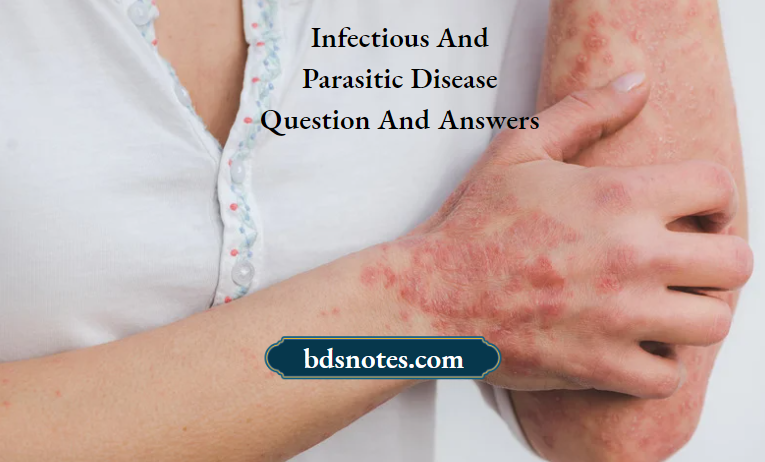
“Importance of studying infectious and parasitic diseases for better healthcare outcomes”
Lesions in Filariasis
Symptomatic cases may have two forms of the disease, i.e. an acute form and a chronic form.
- Acute form:
- Filarial fever: The attacks of fever with rigor and with headache and malaise lasting for 3 to 7 days.
- Filarial lymphangitis: The tender inflamed lymphatics are seen as red streaks. It may present with itchy, irregular, erythematous swelling of the skin scattered over the body. It also involves lymphatics of the testis and spermatic cords.
- Filarial lymphadenitis: It occurs mostly in the inguinal area.
“Common challenges in diagnosing and managing infectious and parasitic diseases”
- Chronic form:
- Hydrocele
- Lymphedema: It is most common in the lower limbs.
- Elephantiasis: Chronicity of the process of lymphatic obstruction causes enormous thickening and induration of the skin of legs and scrotum resembling the height of an element hence the name elephantiasis.
- The rupture of the lymphatic varies into the renal pelvis or bladder giving rise to chyluria or lymphuria.
- Tropical Eosinophilic Syndrome: A hypersensitivity reaction to lymphatic dwelling parasites and characterized by chronic cough, wheezing.
“Steps to identify common types of infectious diseases”
Read And Learn More: Pathology Question And Answers
Question 2. Write in short on whooping cough.
Answer:
Whooping cough is a highly communicable acute bacterial disease of children caused by Bordetella pertussis.
“Role of viral infections like influenza and HIV in public health”
- The use of DPT reduces whooping and reduces the prevalence of whooping cough.
- B. pertussis has a strong tropism for the brush border of bronchial epithelium.
- B. pertussis proliferates in bronchial epithelium and stimulates epithelium to secrete mucous.
- Within 7 to 10 days after exposure catarrhal stage begins which is the most infectious stage.
- There is the presence of low-grade fever, rhinorrhea, conjunctivitis, and excess tear production.
- Paroxysm of cough occurs with a whoop that’s why known as whooping cough.
- The condition is self-limiting but may cause death due to asphyxia in infants.
- B. pertussis produces a heat-labile toxin, heat-stable toxin, and a lymphocytosis-producing factor called histamine sensitizing factor.
“Early warning signs of untreated infectious diseases”
Whooping cough Pathology
- The presence of necrotic bronchial epithelium is covered by thick mucopurulent exudates in the respiratory tract.
- In severe cases mucosal erosion and hyperemia are present.
- Peripheral blood shows marked lymphocytosis up to 90%.
- There is also enlargement of lymphoid follicles in bronchial mucosa and peribronchial lymph nodes.
Leave a Reply