Impression Materials
“What are impression materials in dentistry? A detailed question and answers guide”
Die: A reproduction of a prepared tooth made from a gypsum product, epoxy resin, a metal, or refractory material.
Cast: A dimensionally accurate reproduction of a part or parts of the oral cavity or ex- tra oral facial structures produced in a durable hard material.
Model: A positive full-scale replica of teeth, soft tissues, and restored structures used as a diagnostic aid for the construction of orthodontic and prosthetic appliances.

“Understanding impression materials through FAQs: Types, properties, and applications explained”
Polymerization: A chemical reaction that transforms small molecules into large polymer chains.
Syneresis: Expression of fluid into the surface of the gel structure.
Imbibition: Process of water sorption.
Read And Learn More: Basic Dental Materials Notes

“Differential applications of anterior vs posterior impressions: Questions answered”
A review of impression materials

“Importance of studying impression materials for dental professionals: Questions explained”
Polysulphides: Also known as
- First dental elastomers
- Rubber-base impression materials Vulcanizing impression materials
- Mercaptan impression materials
- Thiokol
- Contains lead dioxide polymer that gives polysulfide its characteristic brown color.
- The polymerization reaction is exothermic in nature.
- It has a long setting time of 8 to 12 minutes. it has an unpleasant odor and color. both of these properties cause patients discomfort heat and moisture accelerate the setting time.
- It is messy and stains clothes.
- Shows the highest permanent deformation. if maximal accuracy is to
- be maintained, the cast should be poured within the first 30 minutes.
- Shows high polymerization shrinkage due to loss of the by-product (water).
- Polymerization shrinkage and permanent deformation can be minimized by taking a minimum quantity of impression material and by using the custom acrylic tray.
- Shows the highest tear strength.
- Hydrophobic in nature. So the impression area should be dried before making an impression.
- Shows high flexibility and so the material can be released from undercut areas with minimum stress.
- Causes the lowest cell death count & so biocompatibility is good.
- Polysulphides are the only impression materials that can be elec- troplated.
“Common challenges in mastering impression material knowledge effectively: FAQs provided”
Condensation silicones:
- Also known as room temperature (RTV) silicones.
- Highest curing shrinkage due to evaporation of ethyl alcohol byproduct. to avoid this, cast should be poured within the first 30 minutes.
- Less permanent deformation than polysulphides.
- Pleasant color and odor.
- Low tear strength.
- Hydrophobic in nature.
- Flexibility is high when compared with polysulphides. So, the impression can be removed from undercuts without distortion. Has a limited shelf life because of oxidation of the tin component.
- Handling latex globes is contraindicated.
Addition silicones (pseudoplastic impression materials):
- Also known as polyvinyl siloxane or vinyl poly siloxane im- precision materials.
- No volatile by-product.
- Lowest curing shrinkage and lowest permanent deformation with best dimensional stability. So casts can be poured after several hours.
- Extremely hydrophobic.
- Shows the least setting time of all the elastomeric impression materials.
- Handling with latex gloves is not indicated because the sulfur present in the natural latex gloves inhibits the settings of the addition of silicone impression materials.
- Shows good shelf life than condensation silicones.
- Hydrophobic in nature.
- Vinyl impression materials can be disinfected by immersing in 10% hypochlorite or 2% glutaraldehyde solutions.
- Sometimes hydrogen may be evolved and may cause pinpoint voids in stone casts.
“Why are impression materials critical for modern dentistry? Answered”
Polyether:
- First elastomer is to be developed primarily to function as an impression material. All the other materials were adapted for other uses.
- Stiffest of all elastomeric impression materials. So extremely difficult to remove from undercut areas because of the high modulus of elasticity.
- High tear strength next to polysulphides.
- Dimensionally more stable. The casts can be poured immediately or after several hours, or after several days. Pouring up the im- precision and removing the cast several times does not alter the dimensional stability of the polyether.
- Shows the highest cell toxicity and so the biocompatibility is not good.
- Hydrophilic in nature. (Note: Agar and alginate are also hydrophilic).
Impression Compound (ADA – 3)
Applications: For making a primary impression, individual teeth impression

“Factors influencing success with impression material selection: Q&A”
Composition:
- Rosin 30%
- Copal resin 30%
- Carnauba 10%
- Rest-Stearic acid, talc, coloring agents.
2. Alginate (ADA 18)
- Type 1 Fast setting
- Type 2 Normal setting
“Early warning signs of gaps in understanding impression types: Common questions”
Applications: Impression making
- When there are undercuts in the mouths with the excess flow of saliva.
- For partial denture with a clasp.
- This is to make an impression on orthodontic and study models.
Composition:
Esters of
- Alginic acid – 15%
- CaSO4-16%
- Zinc phosphate – 4%
- K Ti fluoride
- Diatomaceous earth
- Nas PO
- Coloring and flavoring agent


“Steps to explain types of impression materials: Alginate vs silicone-based vs polyether: Q&A guide”
Zinc Oxide Eugenol Impression Paste (ADA 16) [SPOTTER]
- Type 1 Hard
- Type 2 Soft
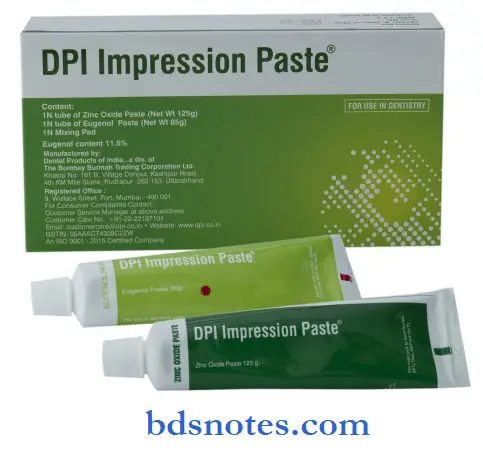
Composition:

“Role of alginate in creating cost-effective impressions: Questions answered”
Uses:
- Cementing and Insulating medium.
- Temporary fillings
- Root canal filling material.
- Bite registration paste.

“How does silicone-based material improve precision? FAQ explained”

Leave a Reply