• Skip to main content
  • Skip to secondary menu
  • Skip to primary sidebar
  • About Us
  • Terms of Use
  • Privacy Policy
  • Disclaimer
  • Contact Us
  • Sitemap

BDS Notes

BDS notes, Question and Answers

  • Public Health Dentistry
  • Periodontics
  • Pharmacology
  • Pathology
  • Orthodontics
    • Anchorage In Orthodontics
    • Mandibular Growth, Functional Matrix
    • Retention and Relapse
  • General Surgery
    • Cysts: Types, Causes, Symptoms
    • Maxillofacial Fractures, Disorders, and Treatments
    • Lymphatic Disorders
    • Neurological and Facial Disorders
  • Temporal And Infratemporal Regions
    • Spinal and Neuroanatomy
  • Dental Materials
    • Dental Amalgam
Home » Host Microbial Interaction In Periodontal Disease

Host Microbial Interaction In Periodontal Disease

December 4, 2023 by Tanuja Puram Leave a Comment

Microbial Host Interaction With Periodontal Disease

Write short note on prostaglandins.
Answer. Prostaglandins are arachidonic acid metabolites generated by cyclooxygenases.

“Understanding the role of bacteria in periodontal disease progression”

  • Arachidonic acid is a 20-carbon polyunsaturated fatty acid found in the plasma membrane of most cells.
  • COX-2 is upregulated by IL-lb, TNF-a, and bacterial LPS and appears to be responsible for generating the prostaglandin (PGE2) that is associated with inflammation.
  • The primary cells responsible for PGE2 production in the periodontium are macrophages and fibroblasts. PGE2 is increased in periodontal sites demonstrating inflammation and attachment loss.

“Importance of studying host-microbial interactions for dental professionals”
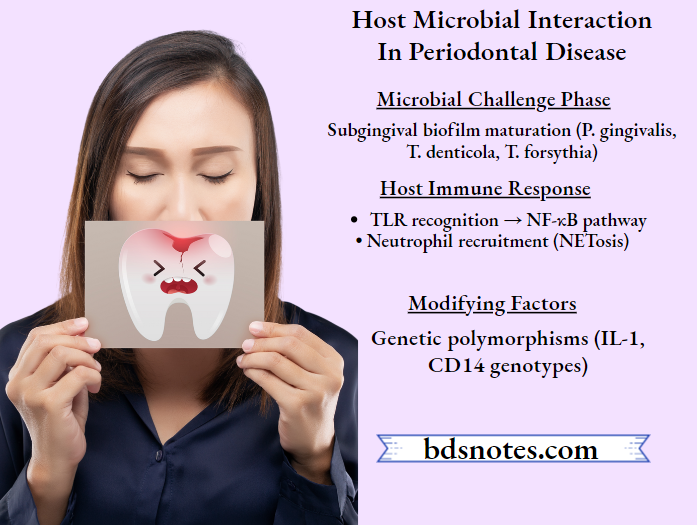
Host Microbe Interaction Periodontitis Pathogenesis

“Common challenges in managing host-microbial interactions in periodontics”

Read And Learn More: Periodontics Question And Answers

  • Induction of MMPs and osteoclastic bone resorption is induced by PGE2.
  • PGE2 appears to be partly responsible for the bone loss associated with periodontitis.
  • PGE2 is elevated in gingivitis and periodontitis, particularly in active disease.

“Role of diagrams and lab experiments in explaining biofilms”

  • Studies in vitro demonstrated that bone loss associated with several periodontal pathogens was inhibited in part by inhibitors of prostaglandin synthesis.
  • PGE2 release from monocytes of patients with severe or aggressive periodontitis is greater than that from patients with little or no periodontal destruction.

Filed Under: Periodontics

Reader Interactions

Leave a Reply Cancel reply

Your email address will not be published. Required fields are marked *

Primary Sidebar

Recent Posts

  • Branchial Cleft Cyst: Background, Pathophysiology, Etiology
  • Maxillary Nerve: Origin, Course, And Branches
  • The Father Of Anatomy And A Great Anatomist Herophilus
  • Bone Structure – Anatomy
  • The External Carotid Artery: Anatomy, Branches, And Functions
  • Occipitofrontalis Muscle
  • Superficial Temporal Artery
  • Platysma Muscle
  • Cartilage
  • Cauda Equina And Conus Medullaris Syndromes
  • Subcutaneous Injections And Device Management
  • Types Of Circulation: Pulmonary, Systemic, And Portal
  • Structure Of Skeletal Muscle
  • Elastic Cartilage
  • Cellular Organelles And Structure
  • The Golgi Apparatus – The Cell
  • The Cytoplasmic Inclusions Of Certain Plant Cells
  • Dental Abscess
  • Laser Surgery
  • Our Facial Muscles And Their Functions

Copyright © 2026 · Magazine Pro on Genesis Framework · WordPress · Log in