• Skip to main content
  • Skip to secondary menu
  • Skip to primary sidebar
  • About Us
  • Terms of Use
  • Privacy Policy
  • Disclaimer
  • Contact Us
  • Sitemap

BDS Notes

BDS notes, Question and Answers

  • Public Health Dentistry
  • Periodontics
  • Pharmacology
  • Pathology
  • Orthodontics
    • Anchorage In Orthodontics
    • Mandibular Growth, Functional Matrix
    • Retention and Relapse
  • General Surgery
    • Cysts: Types, Causes, Symptoms
    • Maxillofacial Fractures, Disorders, and Treatments
    • Lymphatic Disorders
    • Neurological and Facial Disorders
  • Temporal And Infratemporal Regions
    • Spinal and Neuroanatomy
  • Dental Materials
    • Dental Amalgam
Home » HMP Shunt Pathway

HMP Shunt Pathway

August 23, 2025 by Kristensmith Taylor Leave a Comment

HMP Shunt Pathway

Question 1. HMP Shunt Pathway.
Answer.

Characteristic Features Of HMP Shunt Pathway

  • HMP shunt (hexose monophosphate shunt) is an alternate pathway for the oxidation of glucose
  • HMP shunt is also known as
  • Pentose phosphate pathway
  • Pentose cycle
  • Phospho-gluconate pathway
  • Warburg-Dickens-Lipmann pathway
  • Direct oxidative pathway
  • HMP shunt is a multi-cyclic process
  • It is not meant to provide energy
  • It provides NADPH, which is required for various metabolic pathways
  • It provides pentoses, which are required for nucleic acid synthesis
  • Deficiency of the enzyme glucose 6-phosphate dehydrogenase (G6PD) of the HMP shunt pathway can cause haemolytic anemia
  • It occurs in certain specialized tissue,s e.g., liver, adipose tissue, RBCs, testes, ovary, adrenal cortex, lactating mammary gland, lens, and cornea of the eye
  • Carbon dioxide is produced in this pathway
  • It takes place in the cytosol
  • ATP is required for the HMP shunt pathway, but ATP is not produced.

HMP Shunt Pathway: Key Enzymes and Reactions
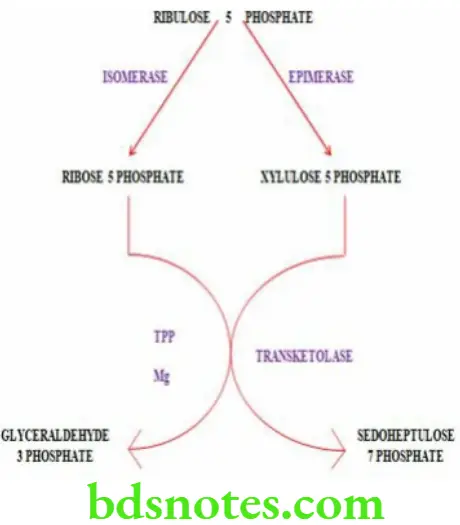
Nutrition And Biochemistry Composition And Metabolism Of Carbohydrates HMP 1

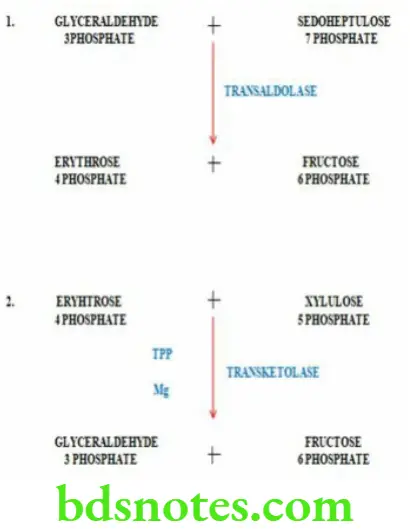
Nutrition And Biochemistry Composition And Metabolism Of Carbohydrates HMP 2

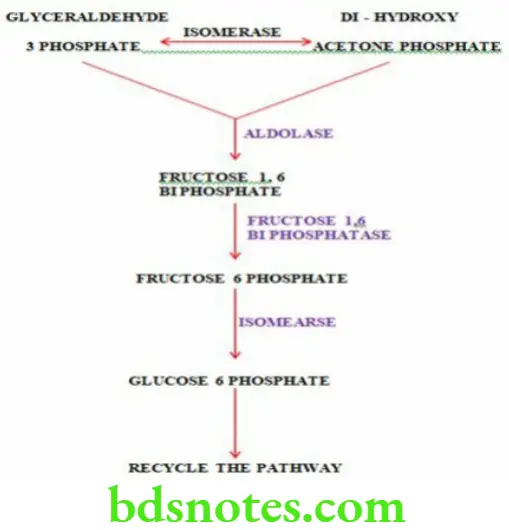
Nutrition And Biochemistry Composition And Metabolism Of Carbohydrates HMP 3

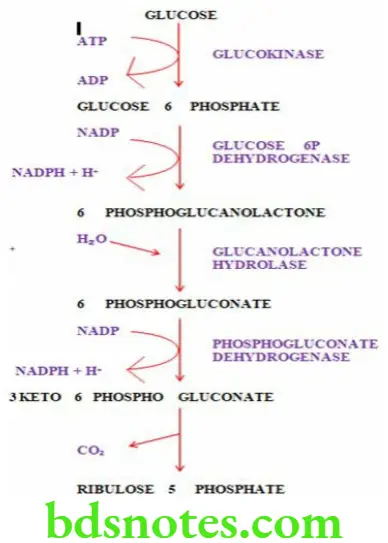
Nutrition And Biochemistry Composition And Metabolism Of Carbohydrates HMP 4

Question 2. Gluconeogenesis.
Answer.

Gluconeogenesis Definition

The formation of glucose from non-carbohydrate sources is known as gluconeogenesis

  • Gluconeogenesis meets the requirement for glucose in the body when carbohydrates are not available in sufficient amounts in the diet
  • Glucose is the only source of energy for nervous tissue and erythrocytes
  • Glucose is required to maintain levels of intermediates of the Krebs cycle
  • It is a source of glycerol phosphate, which is required for the adipose tissue
  • It is a precursor of milk suga,r lactose, for the lactating mammary gland
  • Glucose is the only source of energy for skeletal muscles in anaerobic conditions

Hexose Monophosphate Shunt (HMP) Pathway Explained

Sites Of Gluconeogenesis

Gluconeogenesis takes place in the liver and kidneys

Filed Under: Nutrition And Biochemistry

Reader Interactions

Leave a Reply Cancel reply

Your email address will not be published. Required fields are marked *

Primary Sidebar

Recent Posts

  • Branchial Cleft Cyst: Background, Pathophysiology, Etiology
  • Maxillary Nerve: Origin, Course, And Branches
  • The Father Of Anatomy And A Great Anatomist Herophilus
  • Bone Structure – Anatomy
  • The External Carotid Artery: Anatomy, Branches, And Functions
  • Occipitofrontalis Muscle
  • Superficial Temporal Artery
  • Platysma Muscle
  • Cartilage
  • Cauda Equina And Conus Medullaris Syndromes
  • Subcutaneous Injections And Device Management
  • Types Of Circulation: Pulmonary, Systemic, And Portal
  • Hierarchical Organization Of Skeletal Muscle Tissue
  • Elastic Cartilage Histology Short Note For Medical Exams
  • Cellular Organelles And Structure
  • The Golgi Apparatus – The Cell
  • The Cytoplasmic Inclusions Of Certain Plant Cells
  • Dental Abscess
  • Laser Surgery
  • Our Facial Muscles And Their Functions

Copyright © 2026 · Magazine Pro on Genesis Framework · WordPress · Log in