Headgear
Write short note on headgear.
Or
Write short note on components and types of headgear.
Answer. Headgears are the most widely used extraoral orthopedic appliances.
- They are mainly used in the management of skeletal class 2 malocclusion by growth modification.
- They are also used for the distalization of maxillary molars, as well as for reinforcing intraoral anchorage.
- A typical headgear is attached to the teeth via a face bow and is anchored from the back of the head/neck by means of head cap/neck strap.
“Understanding the role of headgear in orthodontic treatment”
Components of Headgear
Following are the components of a headgear:
- Force delivering unit i.e. Facebow or J hook
- Force generating unit
- Anchor unit, i.e. Head cap or neck strap
Force Delivering Unit
- Facebow: This is the handle through which the force of headgear is transmitted to jaws and dentition. Mainly this is the force delivery unit. Facebow is fabricated by heavy stainless steel gauge wire. It consists of two parts, i.e. outer bow and inner bow and a junction.
- J hook: Headgear can be directly engaged to the loops on the archwire of the fixed appliances. This is known as J hook headgear.
“Importance of studying headgear for better orthodontic outcomes”
Force Generating Unit
- It is the force-generating element of the assembly, which produces heavy forces to effect skeletal changes.
- Force generating unit also connects the facebow to the anchor unit (head cap or neck strap).
- Force-generating unit may be in the form of springs, elastics, or other stretchable materials.
- The force thus produced is delivered to the teeth through the Facebook and then to the underlying skeletal structures via teeth
Anchor Unit
- Headgear appliance derives anchorage from extraoral sites using the rigid bones of the skull and/or the back of the neck.
- Two basic types of extraoral attachments provide anchorage for headgear:
- Cervical attachment/ neck strap
- Occipital attachment/ head cap
- A combination of cervical and occipital attachments may also be used to distribute the external forces over a wide surface area.
“Common challenges in using headgear effectively”
Types of Headgear
Following are the types of headgear according to the site from which anchorage is obtained
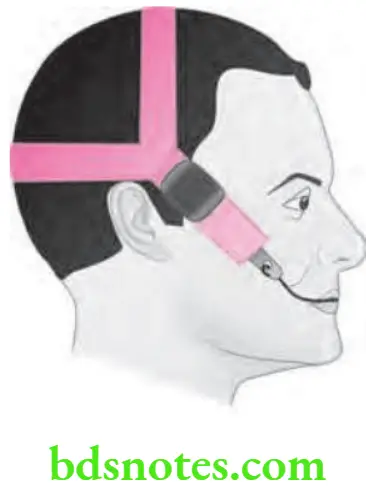
High pull or Occipital Headgear:
In this head, the cap is attached to the back of the head in the occipital region or junction of the occipital and parietal regions. This is indicated in high mandibular angle cases. This provides superior and distal force to both maxilla and maxillary dentition.
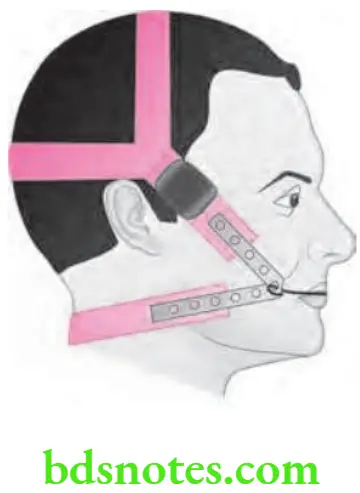
Straight or Medium Pull Headgear or Combination Pull Headgear:
Combination pull headgear has both occipital and cervical straps. It is indicated in normal mandible angle cases. If the level of force of both the straps is equal, then there is a distal and slight upward force on the maxilla as well as teeth.
“Steps to explain different types of headgear in orthodontics”
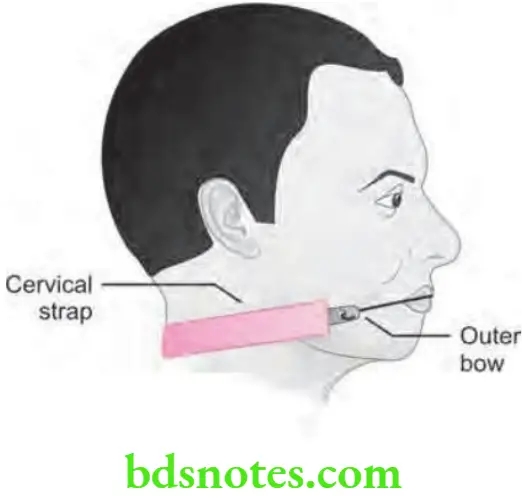
Cervical or Low Pull Headgear:
Its anchorage is from the nape of the neck. It applies distal force and also exerts an extrusive component of force on maxillary molars. It is indicated in cases of Class 2 division 2 malocclusion.
“Role of cervical pull vs high-pull headgear in orthodontic treatment”
“Early warning signs of issues with headgear usage”
“Asymptomatic vs symptomatic effects of improper headgear use”
Uses of Headgear
- For intrusion of molars and incisors by high pull headgear.
- For uprighting of molars
- For expansion or contraction of the arch
- To reduce the overjet
- For space maintenance and space regaining
- For retention of molar correction done by other techniques
- For reinforcement of anchorage during fixed appliance treatment.
- For visualization of maxillary first molars.
Leave a Reply