Postnatal Development of Mandible
Describe the modes by which the mandible grows from birth to adulthood.
Answer.
Postnatal Development of Mandible.
- Of all the facial bones, the mandible undergoes a large amount of post-natal growth and undergoes the largest variability in its morphology.
- In postnatal life, mandibular growth shows the integration of both the periosteal and the capsular matrices of the functional matrix theory. The capsular matrix involves the oropharyngeal functional spaces, and growth of the mandible occurs as per the functional needs of a particular functional system. The process of surface remodeling involves the activity of the periosteal matrix. i.e., muscle fier.
“Understanding the role of postnatal mandibular development in facial growth: Q&A explained”

“Importance of studying postnatal mandibular development for better outcomes: Questions explained”
Postnatal Development of Mandible During Birth
- During birth, the size of the mandible is very small.
- Condyles of the infant mandible are low and lie at the position of the occlusal plane.
- Ramus of the mandible in infants is horizontal and consists of an obtuse gonial angle.
Read And Learn More: Mandibular Growth, Functional Matrix Theory & Space Maintainers in Orthodontics
“Common challenges in understanding postnatal mandibular growth: FAQs provided”
Postnatal Development of Mandible During First Year
- During the first year of life, the symphyseal suture grows, and there is a lateral expansion of the symphyseal suture anteriorly to accommodate the erupting anterior teeth.
- The mental foramen is directed at 90° tothe the surface of the condyle.
- The posterior surface of the mandible shows more deposition of bone.
- As the condyle and glenoid fossa are flat, this leads to anteroposterior movement of the mandible.
Growth of Mandible in an Adult/Concepts of V-Principle
As the child becomes an adult, the mandible shows various changes, i.e., The
“Steps to explain different stages of postnatal mandibular development: Infancy vs adolescence: Q&A guide”
- Ramus of the mandible becomes long.
- The gonial angle becomes less obtuse.
- Condyles of the mandible are well-developed
- All over the bone becomes large.
V-Principle of Growth of Mandible
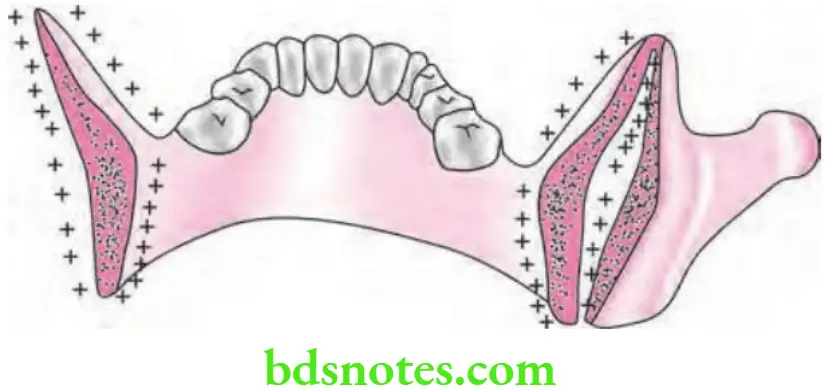
Growth of the mandible occurs in the form of expanding V.
“Role of sutural growth in postnatal mandibular development: Questions answered”
Length of the Mandible
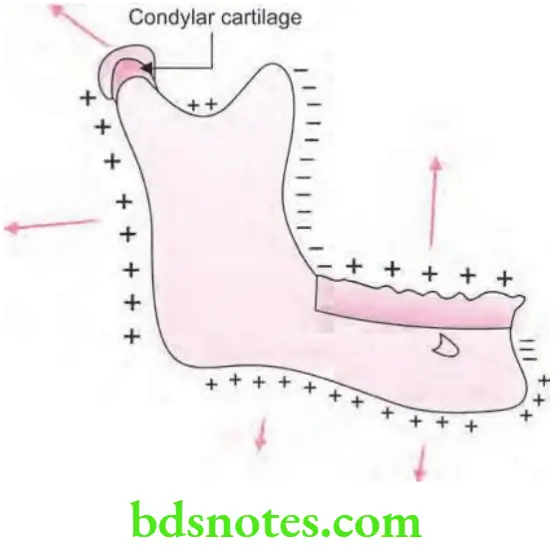
- The mandible grows in length anteroposteriorly by bone deposition at the posterior surface of the amus and resorbing the leading edge at the anterior surface.
- By this deposition and resorption of bone, the mandible lengthens.
- The anterior part of the ramus of the mandible in the future is occupied by the posterior part of the body of the mandible.
- As the occupancy occurs, permanent molars develop in it.
- Posterior growth of the mandible causes its anterior displacement. This is because the articulation of the condyle to the glenoid fossa is constant.
- Anterior displacement brings about a change in the mandible.
- Opening of the mental foramen faces backward as there is anterior growth of the mandible. This causes the neurovascular bundle to leave the foramen directed backward.
- Surface remodeling occurs at the anterior border of the mandible.
- Bone deposition occurs at the posterior surface of the symphysis, while bone resorption occurs at the superior part of the anterior surface. Bone deposition is also present at the inferior aspect.
“Early warning signs of abnormalities in postnatal mandibular growth: Common questions”
“Asymptomatic vs symptomatic effects of ignoring mandibular growth issues: Q&A”
The width of the Mandible
- Over the lateral surface of the ramus of the mandible, deposition of bone occurs while resorption of bone occurs towards the lingual surface below the mylohyoid ridge.
- The coronoid process of the mandible undergoes deposition of bone at the mesial surface and resorption at the lateral surface and leads to the expansion of the mandible like V.
- The condyle of the mandible undergoes resorption of bone over the lateral aspect of the neck of the condyle and deposition of bone over the medial aspect of the neck of the condyle. This leads to an increase of neck of condyle in the length.
- Following the V principle, the distance between the ramus of the mandible is increased as the mandible grows. In this way, the mandible keeps pace with the growth of the cranial base.
- The mandible establishes its orthognathic relation with the maxilla in adult life as it grows in its length.
- The periosteal matrix influences the angle, coronoid, and condylar processes.
Height of Mandible
- As the teeth erupt, the height of the alveolar process increases.
- At the lower border of the mandible, deposition of bone occurs, which increases the height ofthe mandible.
“Steps to educate patients about postnatal mandibular development and its importance: Q&A format”
Rotation of Mandible
- Bjork used implants to study the growth pattern of the mandible and found that the mandible underwent growth rotation. It was seen that the mandible undergoes the growth rotation, the effects seen are minimal because of external compensation . The conclusion was formed that the growth of the mandible is largely influenced by functional matrices, and the condylar cartilage has little influence on its overall growth.
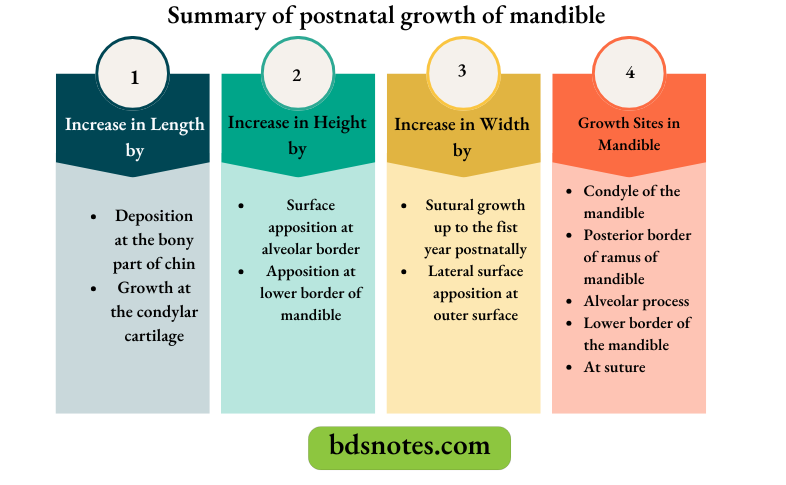
Summary of postnatal growth of mandible
Leave a Reply