Glycogenesis And Gluconeogenesis
Glycogenesis.
Answer.
Glycogenesis/Glycogen Synthesis Definition
Glycogenesis is the formation of glycogen from glucose
Glycogenesis/Glycogen Sites
- Glycogenesis takes place in the liver and skeletal muscles
- Storage capacity of glycogen in a normal adult man (70 kg) is
- Liver – 70 to 110 grams
- Skeletal muscles- 240 to 250 grams
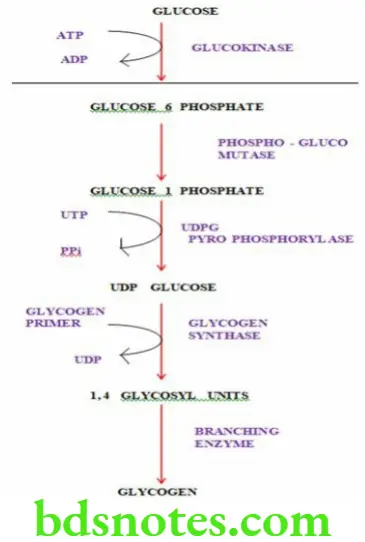
Reactions Of Glycogenesis
- Glucose is phosphorylated to glucose 6 phosphate by the enzyme glucokinase
- Glucose 6 phosphate is converted to glucose 1 phosphate by the enzyme phosphoglucomutase
- Glucose 1 phosphate then reacts with UTP (uridine triphosphate) to form UDP glucose (uridine diphosphate glucose) under the influence of the enzyme UDPG pyrophosphorylase
- C1 of the glucose of UDP glucose forms a glycosidic bond with the C4 of glucose of glycogen primer
- The enzyme required is glycogen synthase and UDP is liberated in the reaction
- A pre-existing glycogen primer must be present to initiate the reaction
- In this way an existing glycogen chain can be repeatedly extended by one glucose unit at a time.
- When the chain has lengthened to a minimum of 11 glucose units, branching enzyme transfers 6 glucose units, thus establishing a branch point in the molecule
- The branches grow by further additions and further branching
- 2 ATP’s are required for glycogenesis.
Leave a Reply