Glucose Handling By The Kidneys: Health And Diabetes Explained
Question 1. Glucose reabsorption in the kidneys in health and diabetes mellitus.
Answer:
Glucose reabsorption in health:
- Glucose is completely reabsorbed in kidneys
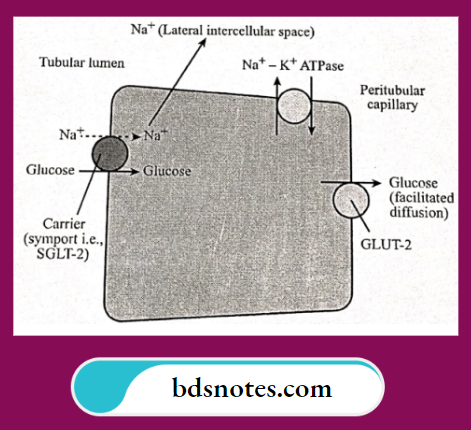
- It is actively transported through sodium cotransport mechanism
- According to it, glucose and sodium binds to common carrier called sodium dependent glucose transporter (SGLUT)-2
- By SGLUT-2, glucose and sodium is carried from luminal membrane into cell
- Energy produces by Na+ K+ ATPase helps to pump Na+ out of the cell into lateral intercellular spaces While glucose is transported from tubular cell into medullary interstitium by carrier protein called glucose transporter 2 (GLUT-2)
Glucose reabsorption in diabetes:
- Glucose reabsorption and excretion depends on plasma glucose concentration, PG
- Thus urine excretion rate increases with increase in plasma glucose concentration
- The plasma glucose level at which glucose first appears in urine is called renal threshold of glucose
- Value:
- Renal threshold of arterial plasma 200 mg/dl
- Renal threshold of venous plasma 180 mg/dl
Question 2. Functions of kidney.
Answer:
Functions of Kidney:
- Role in homestasis
- Kidney regulates carious activities in the body which are concerned with homeostasis
- Filter the blood and excrete its waste products
- Conserves water when it decreases and excretes when excess
- Retains sodium when osmolarity decreases and eliminates sodium when osmolarity increases
- Maintains pH of the blood and body fluids
- Kidney regulates carious activities in the body which are concerned with homeostasis
- Hemopoietic function
- Stimulate erythropoiesis by the release of erythropoietin
- Endocrine function
- Hormones secreted by kidney are
- Erythropoeitin
- Thrombopoeitin
- Renin
- 1,25 dihydroxycholecalciferol
- Prostaglandins
- Hormones secreted by kidney are
- Regulation of arterial blood pressure
- Through renin angiotensin mechanism and through maintenance of ECF volume
- Regulation of blood calcium level
- Kidney regulates blood calcium level by activating 1,25 dihydroxycholecalciferol into vitamin D
- Vitamin D helps in absorption of calcium from intestine
Leave a Reply