Glossopharyngeal Nerve
Describe the glossopharyngeal nerve under the following headings:
- Glossopharyngeal Nerve Functional components,
- Glossopharyngeal Nerve Origin and course,
- Glossopharyngeal Nerve Branches and distribution and
- Glossopharyngeal Nerve Applied anatomy.
Answer:
The glossopharyngeal nerve is CN IX. It is a mixed nerve (motor and sensory) but predominantly sensory.
“Understanding the anatomy and functions of the glossopharyngeal nerve through FAQs: Q&A explained”
Vestibulocochlear Nerve Functional Components
- Special visceral of erent (SVE) fibres supply the stylopharyngeus muscle.
- General visceral of erent (GVE) fibres, which supply the secretomotor fibres to the parotid gland.
- Special visceral of erent (SVA) fibres, which carry taste sensations from the posterior one-third of the tongue including vallate papillae.
- General visceral of erent (GVA) fibres, which carry general sensations from the skin of the auricle.
Vestibulocochlear Nerve Origin and Course The glossopharyngeal nerve arises from its nuclei in the brainstem and emerges on the surface from the lateral aspect of the medulla in the groove between the olive and inferior cerebellar peduncle and enters the jugular foramen.
“Importance of studying the glossopharyngeal nerve for medical students: Questions explained”
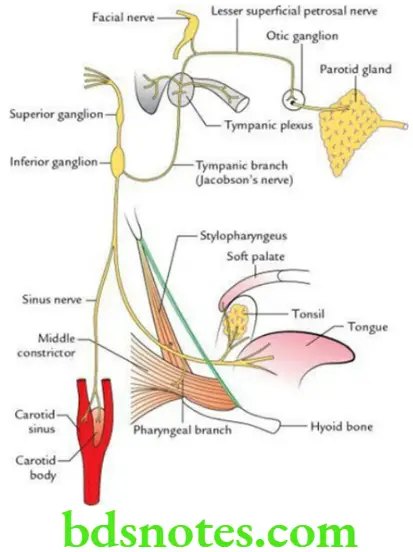
After emerging from the jugular foramen, it descends vertically between the internal jugular vein and internal carotid artery for some distance, then curves around the lateral surface of the stylopharyngeus, and passes forward into the tongue.
“Common challenges in understanding glossopharyngeal nerve anatomy effectively: FAQs provided”
Vestibulocochlear Nerve Branches And Distribution
- Tympanic nerve (Jacobson’s nerve), carrying secretomotor fibres to the parotid gland
- Nerve to stylopharyngeus
- The pharyngeal branch to the pharyngeal plexus
- Sinus nerve to carotid sinus and carotid body
- Terminal branches to the posterior one-third of the tongue including vallate papillae, tonsil, soft palate and epiglottis
“Factors influencing success with glossopharyngeal nerve knowledge: Q&A”
Vestibulocochlear Nerve Applied anatomy
- The paralysis of the glossopharyngeal nerve leads to loss of gag reflex and loss of general and taste sensations in the posterior one-third of the tongue.
- The glossopharyngeal nerve is tested clinically by:
- Eliciting gag reflex: The tickling of the posterior wall of the oropharynx/soft palate/tonsillar region causes reflex contraction of pharyngeal muscles leading to gagging and retching.
- Note: The afferent limb of the gag reflex is formed by the glossopharyngeal nerve, while its efferent limb is formed by the vagus nerve.
- Testing sensations (general and taste) in the posterior one-third of the tongue including vallate papillae.
Leave a Reply