• Skip to main content
  • Skip to secondary menu
  • Skip to primary sidebar
  • About Us
  • Terms of Use
  • Privacy Policy
  • Disclaimer
  • Contact Us
  • Sitemap

BDS Notes

BDS notes, Question and Answers

  • Public Health Dentistry
  • Periodontics
  • Pharmacology
  • Pathology
  • Orthodontics
    • Anchorage In Orthodontics
    • Mandibular Growth, Functional Matrix
    • Retention and Relapse
  • General Surgery
    • Cysts: Types, Causes, Symptoms
    • Maxillofacial Fractures, Disorders, and Treatments
    • Lymphatic Disorders
    • Neurological and Facial Disorders
  • Temporal And Infratemporal Regions
    • Spinal and Neuroanatomy
  • Dental Materials
    • Dental Amalgam
Home » Gas Gangrene

Gas Gangrene

November 29, 2025 by Kristensmith Taylor Leave a Comment

Gas Gangrene

Write The Method Of the Spread Of Gas Gangrene And Write The Staining And Morphology Of the Organism Producing It.
Answer:

Method Of Spread Of Gas Gangrene

Clostridia release collagenase and hyaluronidase that degrade extracellular matrix proteins and contribute to bacterial invasiveness, but their most powerful virulence factors are the many toxins they produce. C. perfringens secretes 12 toxins, the most important of which is alpha toxin.

Alpha toxin is a phospholipase C that degrades lecithin, a major component of the cell membrane, and so destroys red blood cells, platelets, and muscle cells, causing myonecrosis.

The alpha toxin also has a sphingomyelinase activity that contributes to nerve sheath damage. The O toxin binds cholesterol and forms a membrane-destabilizing pore that causes leukocyte lysis in the lesions of gas gangrene.

Gas gangrene

Gas Gangrene Morphology of Organism

Clostridium perfringens leads to gas gangrene. Morphology of C. perfringens is:
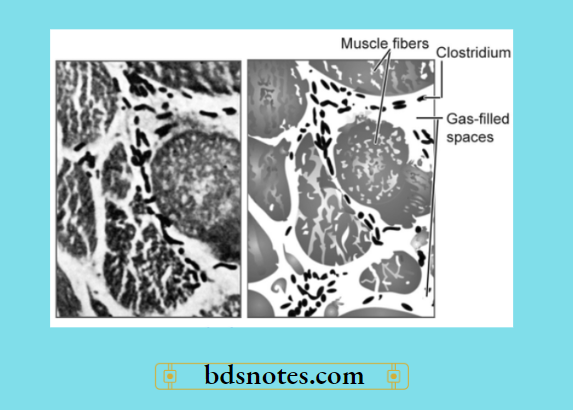
Muscle Fibers Histology

  • It is a plump, Gram-positive bacillus with straight, parallel sides and rounded or truncated ends about 4 to 6 microns × 1 micron.
  • It may occur singly or in chains.
  • It is pleomorphic.
  • It is capsulated and non-motile.
  • It is filamentous, and involution forms are common.

Gas gangrene treatment

Gas Gangrene Staining Of Organism

C. perfringens is stained by Gram stain and is a Gram-positive organism.

Filed Under: Pathology

Reader Interactions

Leave a Reply Cancel reply

Your email address will not be published. Required fields are marked *

Primary Sidebar

Recent Posts

  • Branchial Cleft Cyst: Background, Pathophysiology, Etiology
  • Maxillary Nerve: Origin, Course, And Branches
  • The Father Of Anatomy And A Great Anatomist Herophilus
  • Bone Structure – Anatomy
  • The External Carotid Artery: Anatomy, Branches, And Functions
  • Occipitofrontalis Muscle
  • Superficial Temporal Artery
  • Platysma Muscle
  • Cartilage
  • Cauda Equina And Conus Medullaris Syndromes
  • Subcutaneous Injections And Device Management
  • Types Of Circulation: Pulmonary, Systemic, And Portal
  • Structure Of Skeletal Muscle
  • Elastic Cartilage
  • Cellular Organelles And Structure
  • The Golgi Apparatus – The Cell
  • The Cytoplasmic Inclusions Of Certain Plant Cells
  • Dental Abscess
  • Laser Surgery
  • Our Facial Muscles And Their Functions

Copyright © 2026 · Magazine Pro on Genesis Framework · WordPress · Log in