• Skip to main content
  • Skip to secondary menu
  • Skip to primary sidebar
  • About Us
  • Terms of Use
  • Privacy Policy
  • Disclaimer
  • Contact Us
  • Sitemap

BDS Notes

BDS notes, Question and Answers

  • Public Health Dentistry
  • Periodontics
  • Pharmacology
  • Pathology
  • Orthodontics
    • Anchorage In Orthodontics
    • Mandibular Growth, Functional Matrix
    • Retention and Relapse
  • General Surgery
    • Cysts: Types, Causes, Symptoms
    • Maxillofacial Fractures, Disorders, and Treatments
    • Lymphatic Disorders
    • Neurological and Facial Disorders
  • Temporal And Infratemporal Regions
    • Spinal and Neuroanatomy
  • Dental Materials
    • Dental Amalgam
Home » Functions Of Saliva

Functions Of Saliva

July 26, 2025 by Kristensmith Taylor Leave a Comment

Functions Of Saliva

Question 1. Enumerate any four functions of saliva. Describe the nerve supply to salivary gland and regulation of salivary secretion.
Answer:

Nerve supply to salivary glands:

Salivary glands receive efferent nerve fibers from both parasympathetic and sympathetic divisions of autonomic nervous system.

1. Parasympathetic nerve supply:

1. To parotid gland.

“Understanding saliva through FAQs: Composition, functions, and uses explained”
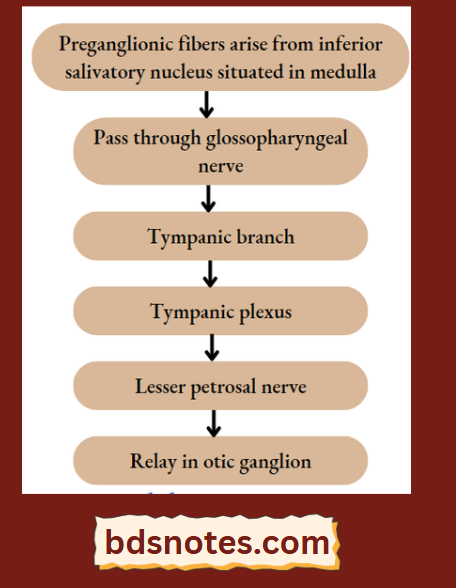
Glossopharyngeal Nerve Pathway To Otic Ganglion

“Importance of studying saliva for dental students: Questions explained”

Postganglionic fibers pass through auriculo temporal nerve to supply the gland.

2. To submandibular and sublingual gland.
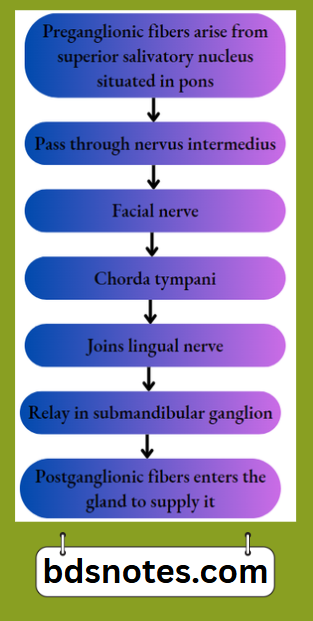
Parasympathetic Pathway To Submandibular Gland

“Common challenges in mastering saliva notes effectively: FAQs provided”

2. Sympathetic nerve supply:

Sympathetic Pathway To Parotid Gland

“Why is proper understanding of saliva critical for diagnosing oral disorders? Answered”

Around middle meningeal artery to supply parotid gland.

Around facial artery to supply submandibular and sublingual gland.

Saliva composition and function

Question 2. Describe the mechanism of gastric secretion.
Answer:

Mechanism of gastric secretion:

1. Secretion of pepsinogen:
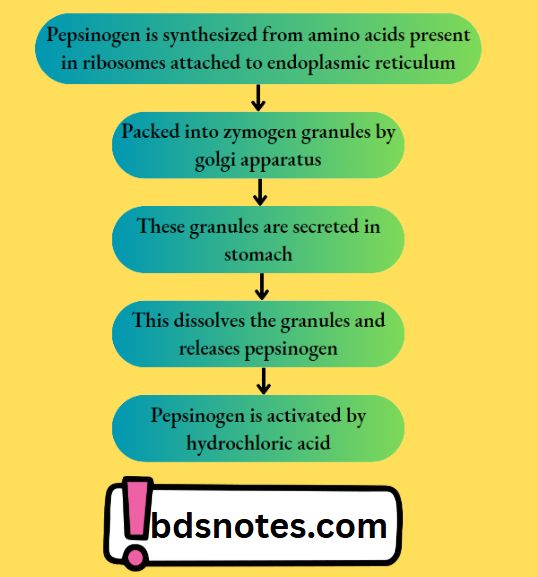
Pepsinogen Secretion And Activation

“Factors influencing success with saliva studies: Q&A”

2. Secretion of hydrochloric acid:

  • According to davenport theory, it is an active process occurring in parietal cells.
  • In parietal cells carbon dioxide is derived from.

1. Blood

2. Metobolic activites of the cell.

↓
Co2 combines with water to form carbonic acid in presence of carbonic anhydrase enzyme.

Carbonic acid splits into [H2CO3→ H‾+HCO3‾]

Salivary amylase function

1. Hydrogen ion- pumped into cnaliculi.

2. Bicarbonate ion.

Bicarbonate enters the blood and combines with sodium ion of sodium chloride and form sodium bicarbonate.

HCO3‾ + Na+ →→ NaHCO3

Hydrogen ion combines with chloride ion to form hydrogen chloride. H+ CT-→HCI

“Steps to explain the functions of saliva: Lubrication vs digestion: Q&A guide”
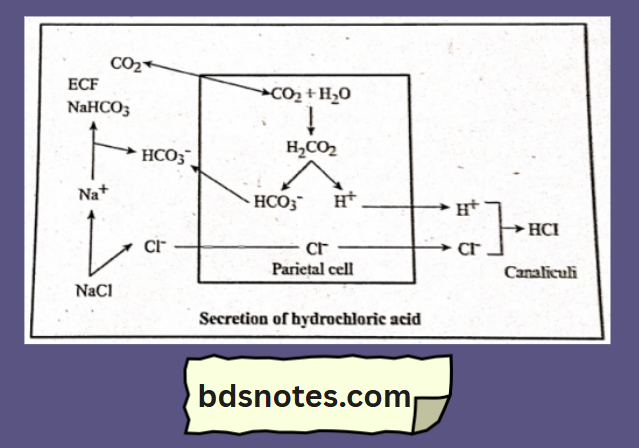
Mechanism Of Hydrochloric Acid Secretion

Filed Under: Anatomy

Reader Interactions

Leave a Reply Cancel reply

Your email address will not be published. Required fields are marked *

Primary Sidebar

Recent Posts

  • Branchial Cleft Cyst: Background, Pathophysiology, Etiology
  • Maxillary Nerve: Origin, Course, And Branches
  • The Father Of Anatomy And A Great Anatomist Herophilus
  • Bone Structure – Anatomy
  • The External Carotid Artery: Anatomy, Branches, And Functions
  • Occipitofrontalis Muscle
  • Superficial Temporal Artery
  • Platysma Muscle
  • Cartilage
  • Cauda Equina And Conus Medullaris Syndromes
  • Subcutaneous Injections And Device Management
  • Types Of Circulation: Pulmonary, Systemic, And Portal
  • Structure Of Skeletal Muscle
  • Elastic Cartilage
  • Cellular Organelles And Structure
  • The Golgi Apparatus – The Cell
  • The Cytoplasmic Inclusions Of Certain Plant Cells
  • Dental Abscess
  • Laser Surgery
  • Our Facial Muscles And Their Functions

Copyright © 2026 · Magazine Pro on Genesis Framework · WordPress · Log in