• Skip to main content
  • Skip to secondary menu
  • Skip to primary sidebar
  • About Us
  • Terms of Use
  • Privacy Policy
  • Disclaimer
  • Contact Us
  • Sitemap

BDS Notes

BDS notes, Question and Answers

  • Public Health Dentistry
  • Periodontics
  • Pharmacology
  • Pathology
  • Orthodontics
    • Anchorage In Orthodontics
    • Mandibular Growth, Functional Matrix
    • Retention and Relapse
  • General Surgery
    • Cysts: Types, Causes, Symptoms
    • Maxillofacial Fractures, Disorders, and Treatments
    • Lymphatic Disorders
    • Neurological and Facial Disorders
  • Temporal And Infratemporal Regions
    • Spinal and Neuroanatomy
  • Dental Materials
    • Dental Amalgam
Home » Functions Of Dental Pulp And Its Zones

Functions Of Dental Pulp And Its Zones

February 5, 2026 by Kristensmith Taylor Leave a Comment

Functions Of Dental Pulp And Its Zones

Question 1. Zones of pulp.
Answer:

1. Odontoblastic zone:

  • It occurs adjacent to the prevention
  • It consists of odontoblasts lining the periphery of the pulp.

2. Cell-free zone of Weil:

  • It is prominent in the coronal pulp.
  • It is a space in which the odontoblast may move pulpward during tooth development and then to a certain extent in functioning teeth.
  • It is inconspicuous during the early stages of rapid dentinogenesis.

3. Cell-rich zone:

  • Adjacent to the cell-free zone Cell density is high in this zone
  • It is composed of fibroblasts and undifferentiated mesenchymal cells.

4. Pulp core:

  • It is characterized by the major vessels and nerves of the pulp.
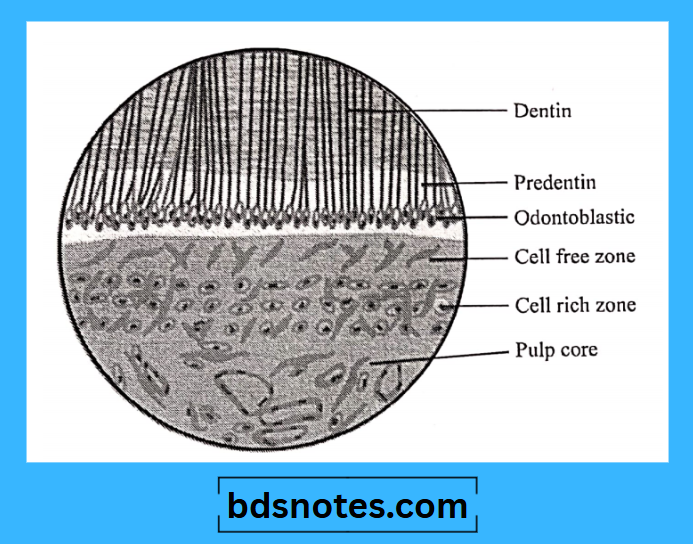
Odontoblast Cell Free Cell Rich Zones

Question 2. Functions of pulp.
Answer:

1. Inductive:

  • Pulp induces the differentiation of dental lamina and results in enamel organ formation.

2. Formative:

  • Pulp produces the dentin that surrounds it.

3. Nutritive:

  • Pulp nourishes the avascular dentin.

4. Protective:

  • It carries nerves that give dentin its sensitivity.

5. Reparative:

  • Pulp is capable of producing new dentin when required.

6. Defensive:

  • Pulp reacts to injury through the inflammatory process.
  • Pulp forms reparative dentin in response to irritations.

Filed Under: Anatomy

Reader Interactions

Leave a Reply Cancel reply

Your email address will not be published. Required fields are marked *

Primary Sidebar

Recent Posts

  • Branchial Cleft Cyst: Background, Pathophysiology, Etiology
  • Maxillary Nerve: Origin, Course, And Branches
  • The Father Of Anatomy And A Great Anatomist Herophilus
  • Bone Structure – Anatomy
  • The External Carotid Artery: Anatomy, Branches, And Functions
  • Occipitofrontalis Muscle
  • Superficial Temporal Artery
  • Platysma Muscle
  • Cartilage
  • Cauda Equina And Conus Medullaris Syndromes
  • Subcutaneous Injections And Device Management
  • Types Of Circulation: Pulmonary, Systemic, And Portal
  • Structure Of Skeletal Muscle
  • Elastic Cartilage
  • Cellular Organelles And Structure
  • The Golgi Apparatus – The Cell
  • The Cytoplasmic Inclusions Of Certain Plant Cells
  • Dental Abscess
  • Laser Surgery
  • Our Facial Muscles And Their Functions

Copyright © 2026 · Magazine Pro on Genesis Framework · WordPress · Log in