Fracture Complications
Question 1. Write a short note on possible complications of fracture healing.
Answer:
Possible Complications
- The fibrous union may result instead of the osseous union if the immobilization of fractured bone is not done. Occasionally, a false joint may develop at the fracture site.
- Nonunion may result if some soft tissue is interposed between fracture ends.
- Delayed union may occur from causes of delayed wound healing in general such as infection, inadequate blood supply, poor nutrition movement and old age.
- Pseudoarthrosis: If a nonunion allows too much motion along the fracture gap, central portion of callus undergoes cystic degeneration and its luminal surface become lined by synovial-like cells creating a false joint called pseudoarthrosis.
Complications of bone fracture
Question 2. Write a short note on chemotaxis.
Answer:
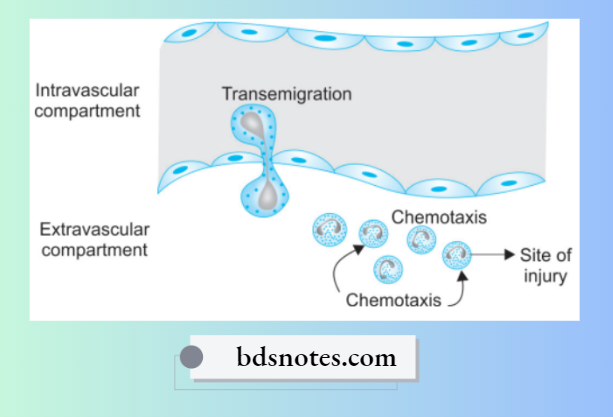
After extravasation, leukocytes emigrate in tissues to ward the site of injury by a process called chemotaxis.
- All granulocytes, monocytes, and, to a lesser extent, lymphocytes respond to chemotactic stimuli with varying rates of speed.
- Both exogenous and endogenous substances can act as chemoattractants.
- The most common exogenous agents are bacterial products. Some of these are peptides that possess an N-formylmethionine terminal amino acid. Others are lipid in nature.
- Endogenous chemical mediators include components of the complement system, particularly C5a; products of the lipoxygenase pathway, mainly leukotriene B4 (LTB4); and cytokines, particularly those of the chemokine family (e.g. IL-8).
- Binding of chemotactic agents to specific receptors on the cell membranes of leukocytes results in activation of phospholipase C, leading to the hydrolysis of phosphatidylinositol-4,5-biphosphate (PIP2) to inositol 1,4,5-triphosphate (IP3) and diacylglycerol (DAG) and the release of calcium, fist from intracellular stores and subsequently from the influx of extracellular calcium. The increased cytosolic calcium triggers the assembly of contractile elements responsible for cell movement.
- The leukocyte moves by extending a pseudopod (lamellipod) that pulls the remainder of the cell in the direction of extension.
- The interior of the pseudopod consists of a branching network of filaments composed of actin as well as the contractile protein myosin.
- Locomotion involves rapid assembly of actin monomers into linear polymers at the pseudopod’s leading edge, cross-linking of filaments, followed by disassembly of such filaments away from the leading edge. These complex events are controlled by the effcts of calcium ions and phosphoinositol on a number of actin-regulating proteins, such as fiamin, gelsolin, profiin, and calmodulin. These components interact with actin and myosin in the pseudopod to produce a contraction.
- Leukocytes appear to migrate in a step-by-step manner in response to one agonist after another, their position is determined by the pattern of attractant receptors they express, and the sequence of chemokine gradients they encounter.
- In addition, the target-derived chemotaxis overrides the host-derived gradients, helping to guide movement to the initiating stimulus.
Delayed union vs nonunion
The following agents act as potent chemotactic substances for neutrophils:
- Leukotriene B4 (LT-B4), a product of the lipooxygenase pathway of arachidonic acid metabolites
- Components of complement system (C5a and C3a in particular)
- Cytokines (interleukins, in particular, IL-8)
- Soluble bacterial products (such as formylated peptides).
Leave a Reply