• Skip to main content
  • Skip to secondary menu
  • Skip to primary sidebar
  • About Us
  • Terms of Use
  • Privacy Policy
  • Disclaimer
  • Contact Us
  • Sitemap

BDS Notes

BDS notes, Question and Answers

  • Public Health Dentistry
  • Periodontics
  • Pharmacology
  • Pathology
  • Orthodontics
    • Anchorage In Orthodontics
    • Mandibular Growth, Functional Matrix
    • Retention and Relapse
  • General Surgery
    • Cysts: Types, Causes, Symptoms
    • Maxillofacial Fractures, Disorders, and Treatments
    • Lymphatic Disorders
    • Neurological and Facial Disorders
  • Temporal And Infratemporal Regions
    • Spinal and Neuroanatomy
  • Dental Materials
    • Dental Amalgam
Home » Forearm Upper Limb Anatomy Notes

Forearm Upper Limb Anatomy Notes

August 11, 2023 by Tanuja Puram Leave a Comment

Forearm Upper Limb Anatomy Notes

Front Of Forearm

Question 1. Describe the flexor retinaculum at the wrist in brief.
Answer.

The flexor retinaculum is a strong fibrous band formed by the thickening of deep fascia in front of the carpal bones (anatomical wrist). It bridges the anterior concavity of the carpus and converts it into an osseofibrous tunnel called the carpal tunnel.

Read And Learn More: Selective Anatomy Notes And Question And Answers

Flexor Retinaculum at Wrist  Attachments

Flexor Retinaculum at the Wrist is rectangular and attached as follows:

  • Medially, to the pisiform bone and the hook of the Hamate
  • Laterally, to the tubercle of the scaphoid and the crest of the trapezium

Forearm Upper Limb Anatomy Notes

“Understanding the anatomy of the forearm and upper limb”
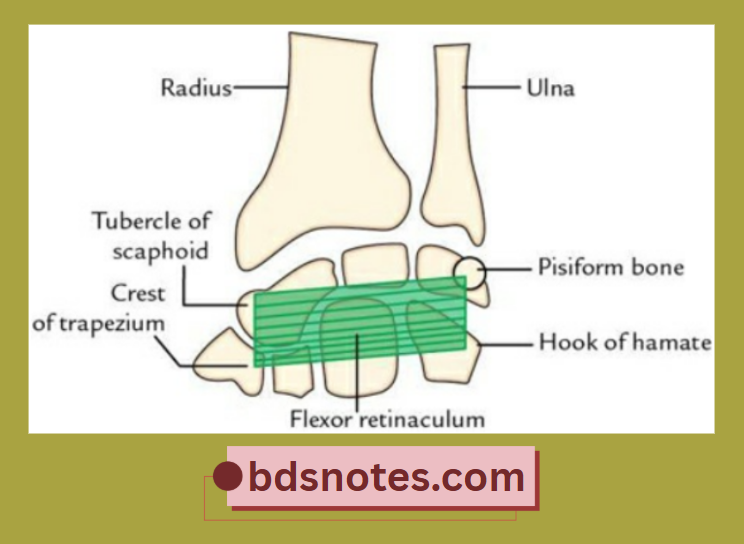
Flexor Retinaculum Carpal Attachments

“Techniques for managing high-risk groups with injuries”

Flexor Retinaculum at Wrist Features

  • Converts the concavity of carpus into an osseofibrous tunnel – the carpal tunnel.
  • Proximally, it gives attachment to the tendon of palmaris longus.
  • Distally, it gives attachment to the apex of the palmar aponeurosis.

Anatomy of the Forearm Upper Limb

“Global prevalence of forearm injuries in athletes”

Flexor Retinaculum at Wrist Superficial Relations

These are

  • Ulnar artery and nerve
  • Palmar cutaneous branch of median nerve
  • Tendon of palmaris longus
  • Superficial palmar branch of radial artery

“Importance of studying forearm anatomy for healthcare professionals”
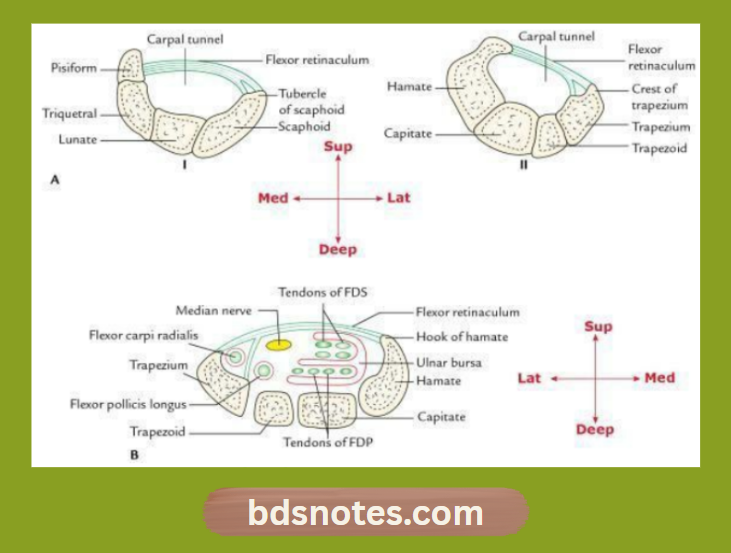
Scaphoid Trapezium Hamate Pisiform Relations

Filed Under: Upper Limb

Reader Interactions

Leave a Reply Cancel reply

Your email address will not be published. Required fields are marked *

Primary Sidebar

Recent Posts

  • Branchial Cleft Cyst: Background, Pathophysiology, Etiology
  • Maxillary Nerve: Origin, Course, And Branches
  • The Father Of Anatomy And A Great Anatomist Herophilus
  • Bone Structure – Anatomy
  • The External Carotid Artery: Anatomy, Branches, And Functions
  • Occipitofrontalis Muscle
  • Superficial Temporal Artery
  • Platysma Muscle
  • Cartilage
  • Cauda Equina And Conus Medullaris Syndromes
  • Subcutaneous Injections And Device Management
  • Types Of Circulation: Pulmonary, Systemic, And Portal
  • Structure Of Skeletal Muscle
  • Elastic Cartilage
  • Cellular Organelles And Structure
  • The Golgi Apparatus – The Cell
  • The Cytoplasmic Inclusions Of Certain Plant Cells
  • Dental Abscess
  • Laser Surgery
  • Our Facial Muscles And Their Functions

Copyright © 2026 · Magazine Pro on Genesis Framework · WordPress · Log in