“What are fluid entrapment and fluid trails? A detailed question and answers guide”
Elastomers with the exception of polyether are generally being hydrophobic require the impression field to be reasonably clean and dry.
Fluid entrapment and fluid trails can occur due to
- Failure to adequately remove water or control saliva in impression field .
- Failure to control bleeding and exudate. Continuos bleeding from injured or inflamed soft tissues near the prepared tooth can result in loss of detail and fluid trails as the blood continues to flow.

“Understanding fluid entrapment and fluid trails through FAQs: Types, mechanisms, and applications explained”
Read And Learn More: Basic Dental Materials Notes
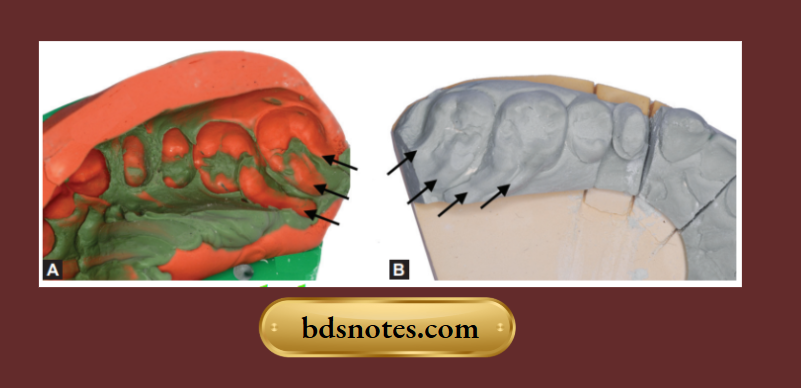
Seating voids or trails
- Seating voids or trails are usually seen when using a ‘single stage putty-wash technique’. The putty tends to displace the light bodied resulting in voids or ‘seating trails’. Seating trails usually correspond to prominent cusps. The void caused by the penetration of the cusp fails to get filled by the wash material because of the displacement. This can cause inaccuracies in the impression especially if it is related to the prepared tooth. Seating trails correspond to the direction of seating.
- For this reason the single stage putty reline technique is not advocated for procedures requiring a high degree of accuracy. The two-stage technique is superior in this regard.
“Importance of studying fluid entrapment and fluid trails for geologists: Questions explained”
Effect Of Provisional Crown Materials (Material Interaction)
A knowledge of material interaction are important to avoid impression errors. According to one study direct contact of polyvinyl siloxane impression materials to some brands of resin based provisional interim fixed prosthodontic materials resulted in polymerization inhibition (delayed setting). The brands tested included Trim Plus, Unifast, Integrity, Systemp C&B, TuffTemp, Protemp IV. Among the elastomers polyether was least affected.
Composite based provisional crown materials like Protemp 4 are used to make direct intraoral provisional (temporary crowns). The material is usually placed on to the tooth in a clear vacuum-formed template (suck-down). Some clinicians use a preoperative putty impression as a template. When a provisional crown is made directly in the mouth using a putty impression as a template. An oily coating of resin also known as the oxygen inhibited layer (OIL) remains on the teeth as well as the impression surfaces after separation of the provisional crown. If the operator continues with the final impression by relining the putty impression in which the provisional crown was made without adequate cleansing of the OIL can result in 2 problems.
- Impaired setting in the area resulting in an inaccurate impression.
- Failure of the wash impression material to bond to the underlying putty resulting in physically separation from the putty.

“Common challenges in mastering fluid entrapment knowledge effectively: FAQs provided”
To ensure accuracy of the impression some precautions which may be observed are
- Thorough physical removal of the OIL from the tooth surface by rubbing with gauze.
- According to one study 3% H2O2 was found to be effective in cleaning the OIL from the tooth.
- Avoid reusing the putty impression template in which provisional was made.
- If the putty template is reused, ensure thorough removal of the OIL by vigorous rubbing with gauze or scraping with putty knife or bur.
- Holding the impression for a slight longer period to ensure complete set.
Specialized Materials
Bite Registration silicones
“Early warning signs of gaps in understanding fluid entrapment mechanisms: Common questions”
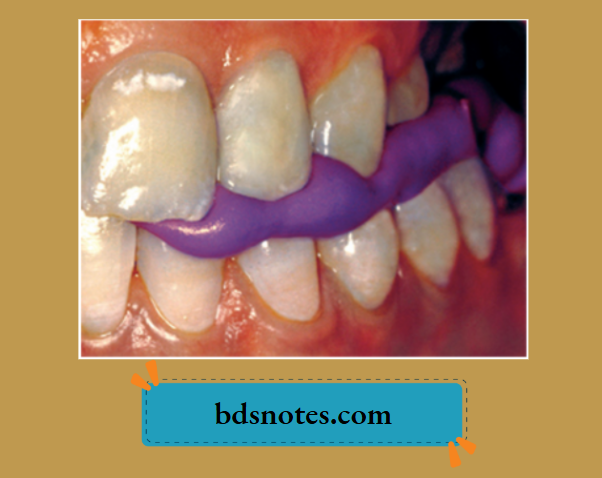
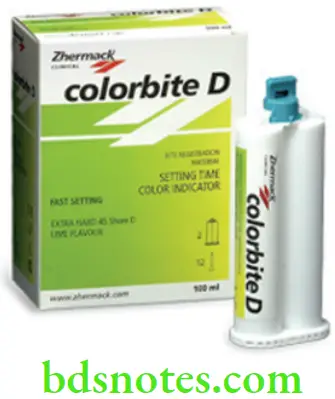
- Registering the three-dimensional relationship between two articulating surfaces is known as bite registration. Many materials are used for this purpose in dentistry. The earliest materials were wax and plaster. A specialized addition type of silicone is increasingly popular as a bite registration material. Unlike the regular impression silicone these materials show greater stiffness and greater hardness (32–45 Shore D), when set. A faster setting time is also important to reduce errors caused by movement and to reduce discomfort to the patient. Setting time ranges from as low as 20 seconds to a minute depending on the type. Other important properties required of these materials is that they should not slump or drip when initially placed. A scannable version has also been introduced for use in CAD CAM (Virtual CADbite Registration, Ivoclar). Most are supplied in cartridge form for use with a caulking gun. Some are supplied in collapsible tubes. One product has thermochromic indicators to help the clinician ascertain setting in the mouth.
Fit checking silicones
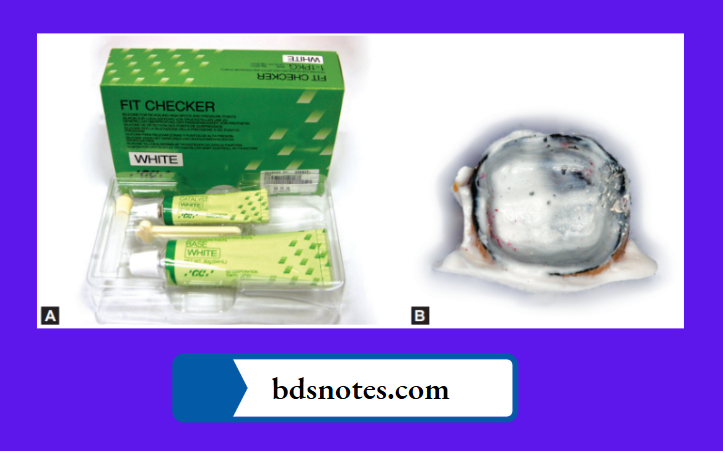
- Another specialized addition type silicone is used for detecting errors in the internal surface of crowns and fixed partial dentures. They are available as a two-paste system. Small but equal lengths of the two pastes are mixed and applied to the internal surface of the crown. The crown is seated on the tooth and the material allowed to set. Areas of premature contact are revealed as bare areas or areas where the internal surface of the crown is showing through. These areas are marked and reduced. The material can also be used to assess the fit of complete and partial dentures.
“Factors influencing success with fluid entrapment analysis: Q&A”
“Steps to explain types of fluid entrapment: Primary vs secondary entrapment: Q&A guide”
Duplicating Silicones
- Duplicating silicones are primarily used in the fabrication process of cast removable partial dentures for constructing duplicate of the master cast in a refractory material (refractory cast). The duplicating silicones were introduced as an alternative to agar duplicating material.
- The material is supplied as base and catalyst in the fluid consistency. They are usually supplied in bulk containers ranging from 250 g to 10 kg.
- They are mixed in a ratio of 1:1. The working time ranges from 2 to 5 minutes. The setting time of these materials are comparatively longer ranging from 10 to 30 minutes. Shore hardness of these materials range from 17 to 26. Like conventional silicones they exhibit a low shrinkage usually in the range of –0.03 to 0.05%. Because of their high dimensional stability and elastic recovery they may be used to create multiple casts.
“Role of primary fluid entrapment in preserving original conditions: Questions answered”

Leave a Reply