• Skip to main content
  • Skip to secondary menu
  • Skip to primary sidebar
  • About Us
  • Terms of Use
  • Privacy Policy
  • Disclaimer
  • Contact Us
  • Sitemap

BDS Notes

BDS notes, Question and Answers

  • Public Health Dentistry
  • Periodontics
  • Pharmacology
  • Pathology
  • Orthodontics
    • Anchorage In Orthodontics
    • Mandibular Growth, Functional Matrix
    • Retention and Relapse
  • General Surgery
    • Cysts: Types, Causes, Symptoms
    • Maxillofacial Fractures, Disorders, and Treatments
    • Lymphatic Disorders
    • Neurological and Facial Disorders
  • Temporal And Infratemporal Regions
    • Spinal and Neuroanatomy
  • Dental Materials
    • Dental Amalgam
Home » Fibroma of the Oral Cavity: Clinical Features, Histology, and Management

Fibroma of the Oral Cavity: Clinical Features, Histology, and Management

July 25, 2025 by Joankessler parkland Leave a Comment

Fibroma of the Oral Cavity: Clinical Features, Histology, and Management

Question. Classify the non­odontogenic tumors of the oral cavity and describe fibroma.
Or
Write a short answer on Forma.

Answer.

Fibroma

Fibroma  is a benign tumor of connective tissue origin.

“Understanding the role of fibroma in oral health: Q&A explained”

Fibroma Clinical Features

  • It is a slow growing lesion and can be seen during 3rd, 4th and 5th decades of life.
  • Female predilection is seen.
  • It can occur anywhere in the oral cavity but most commonly it is seen on buccal mucosa along plane of occlusion. It also affcts gingiva, tongue, buccal mucosa,lips and palate.
  • Lesion appears as elevated nodule of normal color with smooth surface and a sessile or at times pedunculated base.
  • Its size can ranges from several millimeters to centimeters.
  • Lesion if traumatized it become painful.
  • Color of the lesion is pink and texture is smooth.
  • Consistency of lesion can be soft or fim or can be elastic.
  • At times lesion is traumatized and become inflmed and show ulceration or hyperkeratosis.

“Importance of studying fibroma for better diagnostic outcomes: Questions explained”

Fibroma Histopathology

  • Lesion consists of stratifid squamous epithelium which show shortening and fitting of rete pegs.
  • Underlying connective tissue stroma show bundles of interlacing collagen fiers which are interspersed with numerous firoblasts.
  • There is presence of chronic inflammatory cell infitrate
    consisting of lymphocytes and plasma cells.
  • Areas of calcification and ossifiation can also be seen.

“Common challenges in diagnosing fibroma of the oral cavity effectively: FAQs provided”
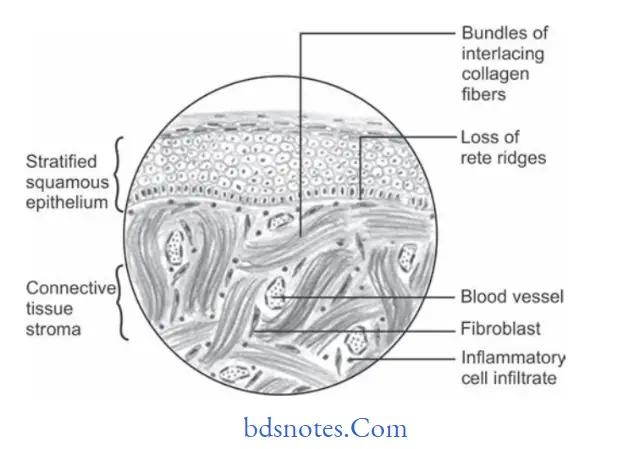
Benign and malignant tumors of Oral cavity Fibroma

“Differential applications of medical vs surgical treatments: Q&A”

Fibroma Treatment

Excision of the lesion should be done.

Filed Under: Oral Pathology

Reader Interactions

Leave a Reply Cancel reply

Your email address will not be published. Required fields are marked *

Primary Sidebar

Recent Posts

  • Branchial Cleft Cyst: Background, Pathophysiology, Etiology
  • Maxillary Nerve: Origin, Course, And Branches
  • The Father Of Anatomy And A Great Anatomist Herophilus
  • Bone Structure – Anatomy
  • The External Carotid Artery: Anatomy, Branches, And Functions
  • Occipitofrontalis Muscle
  • Superficial Temporal Artery
  • Platysma Muscle
  • Cartilage
  • Cauda Equina And Conus Medullaris Syndromes
  • Subcutaneous Injections And Device Management
  • Types Of Circulation: Pulmonary, Systemic, And Portal
  • Structure Of Skeletal Muscle
  • Elastic Cartilage
  • Cellular Organelles And Structure
  • The Golgi Apparatus – The Cell
  • The Cytoplasmic Inclusions Of Certain Plant Cells
  • Dental Abscess
  • Laser Surgery
  • Our Facial Muscles And Their Functions

Copyright © 2026 · Magazine Pro on Genesis Framework · WordPress · Log in