“What are fenestrations and dehiscences in periodontics?”
Fenestration and Dehiscence
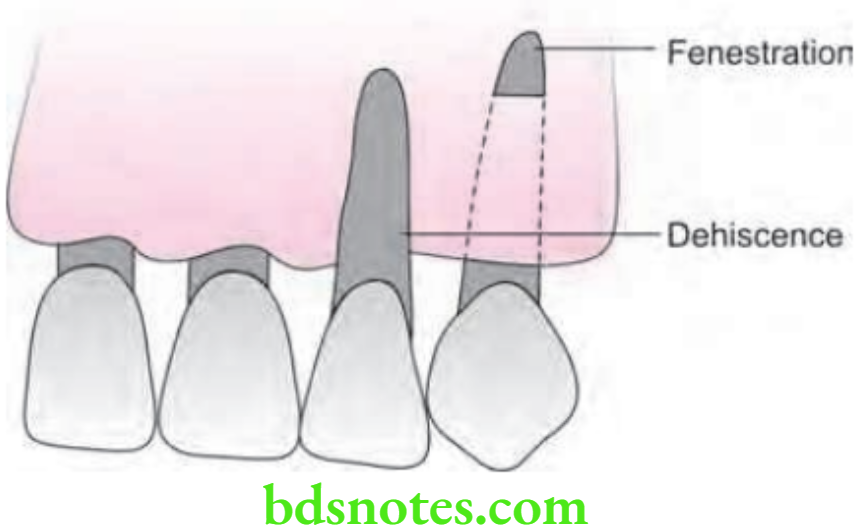
Isolated areas in which root is denuded of bone and the root surface is covered only by periosteum and overlying gingiva is known as fenestration. In these, instances marginal bone is intact.
- When denuded areas extend through the marginal bone, the defect is called as dehiscence.
- Such defects occur approximately in 20% of teeth and they occur more on facial bone than on lingual, are more common on anterior teeth than on posterior teeth, and are frequently bilateral.
- Prominent root contour, malposition and labial protrusion of root combined with a thin bony plate are predisposing factors.
- Fenestration and dehiscence are important because they may complicate the outcome of periodontal surgery.
- Both fenestration and dehiscence are seen at the time of disease in relation to alveolar bone proper.
“Understanding the role of fenestrations and dehiscences in gum health”
Read And Learn More: Periodontics Question And Answers
“Importance of studying fenestrations and dehiscences for dental professionals”
Fenestration and Dehiscence Methods to Detect
- Tactile method: Run finger over the prominent root in apicocoronal and mesiodistal directions. The crest of the bone at the apical extent of the defect may be felt, as may the lateral border. As the figer is moved coronally, the bridge of the bone may be felt at the coronal part of a fenestration but not in dehiscence.
“Emerging research on advanced treatments for fenestrations and dehiscences”
- Bone sounding/transgingival probing: It is done by anesthetizing the tissue locally and inserting the probe horizontally and walking along the tissue tooth interface so that the operator can feel the bony topography. It may be used to differentiate between two types of defects. The sensation transmittd through the probe on touching the tooth is solid and sharp one whereas bone gives softr and mushy sensation. If the sensation is like touching tooth, the probe is moved halfway to the free margin and is pressed through the sof tissue. If the bone is touched the defect is a fenestration and if not, then it is dehiscence.
- Radiography: Cone-beam computed tomography (CBCT) images can show bone dehiscences and fenestrations.
“Role of guided tissue regeneration in managing fenestrations and dehiscences”
Fenestration and Dehiscence Clinical Importance
- The defects are very important clinically because where they occur the root is covered only by the periosteum and overlying gingiva, which may atrophy under irritation and expose the root.
- Before any mucogingival surgical procedure, especially lateral pedicle existence of osseous dehiscence or fenestration should be ruled out.
- In case of gingival grafting procedure, if the receptor site has fenestration defect, soft tissue is capable of reattaching to the exposed surface with higher predictability than dehiscence.
- If the abutment tooth has dehiscence or fenestration, the partial denture will damage the abutment and abutment loss will occur in a short period.
Leave a Reply